Seoul is clean, modern, and beautiful. However, you will quickly notice a strange mystery. There are no trash cans.
Specifically, you can walk for 20 minutes in Gangnam holding an empty iced coffee cup without finding a single bin. It is baffling. In most countries, trash cans are on every corner. In contrast, in Korea, they are hidden treasures.
Welcome to Level 1. Let me share the story of how I carried a sticky cup of juice for 3 hours like a precious trophy.

Level 1: The Mystery of the Missing Bins
Flashback: My first week in Hongdae.
Initially, I bought a delicious Tangerine Juice from a street stall. I drank it happily while shopping. When I finished, I looked around for a bin. There were none. I kept walking. Still none.
After 30 minutes, my hand was sticky. I saw a pile of trash on top of an electrical box. I thought about leaving my cup there. But I felt guilty. “Seoul is so clean,” I thought. “I can’t be the one to ruin it.”
Eventually, I carried that empty plastic cup all the way back to my hotel room. I felt like a fool. Later, I asked myself: “Does the government want me to eat the cup?”
Level 2: The Solution (Where to Look)
I complained to Ssam about this. “Ssam, are trash cans illegal in Korea? Why is it so hard to throw things away?”
Ssam laughed. “Alice, they are not missing. They are just strategically placed.”
Here is the secret map to finding trash cans in Korea:
1. Subway Stations & Bus Stops
First, the most reliable place is the Subway Station.
- Where: Usually near the ticket gates or on the platform.
- Bus Stops: Many major bus stops also have small bins attached to the shelter.
2. Convenience Stores (The Holy Grail)
If you really can’t find one, go to a CU, GS25, or 7-Eleven.
- Rule: You don’t have to buy anything. Just walk in, find the bin (usually near the ramen counter), throw it away, and walk out. However, be polite and say “Thank you.”
3. Cafe Return Trays
Alternatively, if you are holding a coffee cup, you can return it to any branch of the same cafe chain (e.g., Starbucks to Starbucks).
- Tip: Even if it’s a different brand, most nice staff will let you throw it away if you ask politely: “Sseuregi beoryeo-do doelkkayo?” (Can I throw this trash away?)
Level 3: Ssam’s Insight (Why No Bins?)
(The 1995 Law)
You might wonder, “Why make it so hard?” Historically, Korea had trash cans everywhere. However, in 1995, the government introduced the Volume-based Waste Fee System (Jongnyangje).
1. Pay as You Throw People have to buy expensive special bags to throw away household trash. Consequently, if there are public bins, people bring their home trash and dump it there to save money. Therefore, the government removed public bins to stop illegal dumping.
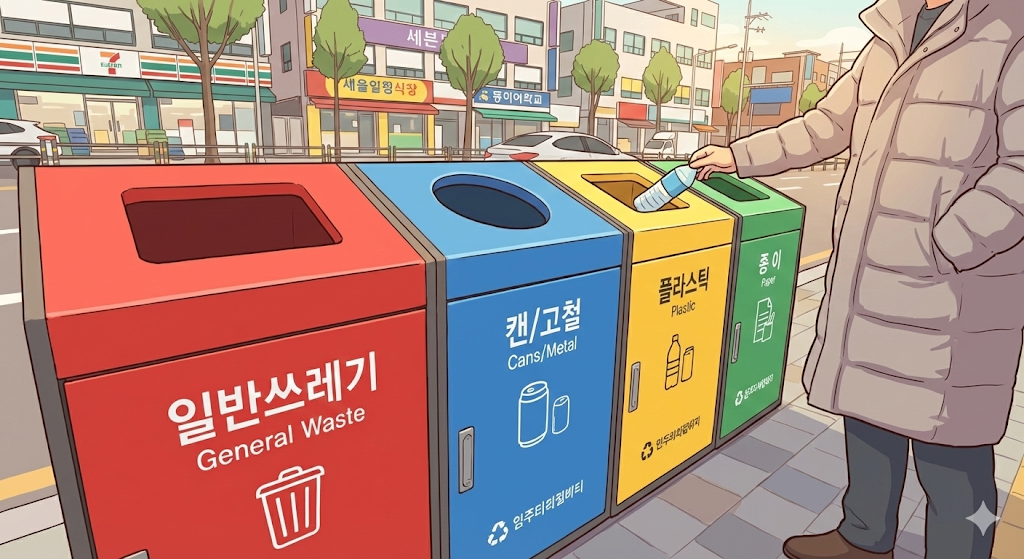
2. Recycling Culture Korea has one of the highest recycling rates in the world. As a result, when you do find a bin, it usually has separate holes for “General Waste” (Ilban) and “Recyclables” (Jaehwal-yong). Make sure you check the picture before you toss.
Level 4: Action Links (Maps & Info)
(Useful info for clean travel)
Finding Toilets (Bins are usually there)
- Naver Map: Search for “Public Toilet” (개방화장실).
- Link: [Naver Map Search]
Alice’s Bottom Line: Plan Your Trash
Don’t buy a sticky snack if you are about to walk 5km. Instead, eat it at the stall, or make sure you are near a subway station.
In Korea, finding a trash can is a treasure hunt. Good luck.
Survival Hangul: Trash Edition
- “쓰레기통 어디 있어요?” (Where is the trash can?)
- “이거 버려주세요.” (Please throw this away for me – to staff).
- “재활용” (Recycling).
Read This Next (Before You Make Another Mistake)
Hands clean? Now explore more.