If you just finished a delicious market food tour, you are probably looking for something to wash it down. Specifically, many visitors think the famous green “chemically diluted” Soju is the only option in Korea. However, Korea has a rich, 2,000-year history of artisanal fermentation made from rice, water, and “Nuruk” (a fermentation starter).
Consequently, if you only drink the cheap stuff from the convenience store, you are missing out on an entire universe of flavors. Fortunately, I have Ssam to teach me the difference between a $2 hangover and a $50 cultural experience.
Welcome to Level 1. Let me tell you about the time I tried to keep up with my Korean friends drinking green bottles and regretted being born the next day.
Level 1: The “Green Bottle” Hangover Mistake
Flashback: My first Korean barbecue night.
Initially, I thought the ubiquitous green bottle Soju was the peak of Korean drinking culture. So, I drank shot after shot, thinking it was just weak vodka. Unfortunately, the artificial sweeteners and low-quality alcohol hit me like a truck the next morning.
Instead of enjoying a cultural experience, I spent the entire day in bed. Eventually, Ssam explained that those bottles are mass-produced industrial alcohol. “Alice, that’s fast food alcohol. You need to try the slow food version!” he said. For this reason, I learned that real Korean alcohol is about flavor, not just getting drunk quickly.
Level 2: The Solution (The Big Three Types)
Immediately, Ssam introduced me to the holy trinity of traditional Korean rice alcohol. “It all starts with rice, but how you filter it changes everything,” he explained.
1. Takju (Makgeolli – The Cloudy One)
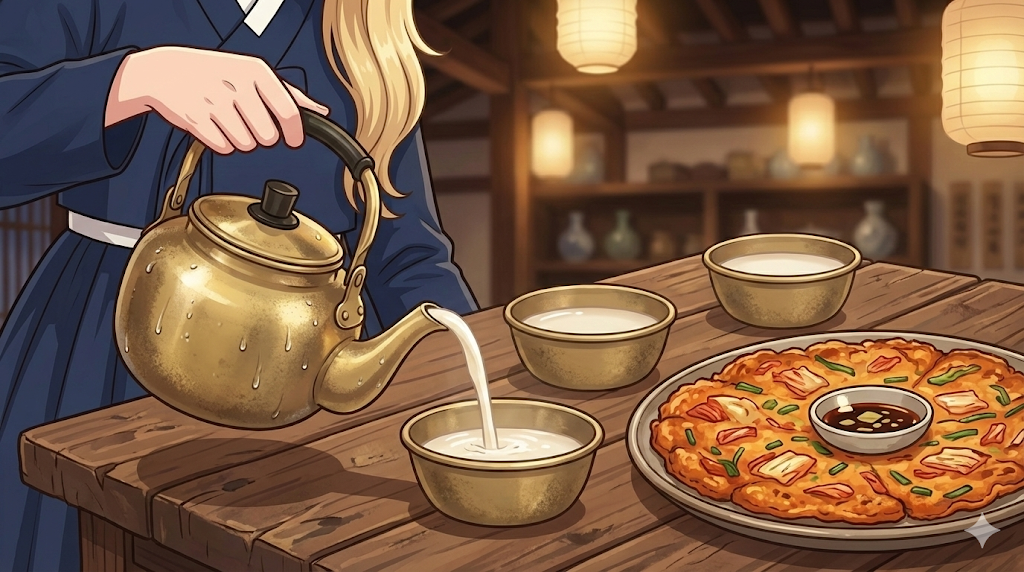
This is the oldest and most popular form. It’s unfiltered rice wine.
- Taste: Creamy, slightly sweet, tangy, and fizzy. It has a low alcohol content (6-9%).
- Perfect Pairing: Greasy foods like Bindaetteok (pancakes) from the market. Indeed, on rainy days, Koreans crave Makgeolli and Jeon (pancakes).
2. Cheongju / Yakju (The Clear One)
If you let Makgeolli sit, the clear liquid that rises to the top is Cheongju.
- Taste: Refined, subtle, and smooth, similar to high-end Japanese Sake or white wine. Alcohol content is medium (13-15%).
- Perfect Pairing: Delicate foods like Yukhoe (beef tartare) or sophisticated Korean court cuisine.
3. Traditional Soju (The Distilled One)
This is the real Soju, made by distilling Cheongju. It is NOT the green bottle stuff.
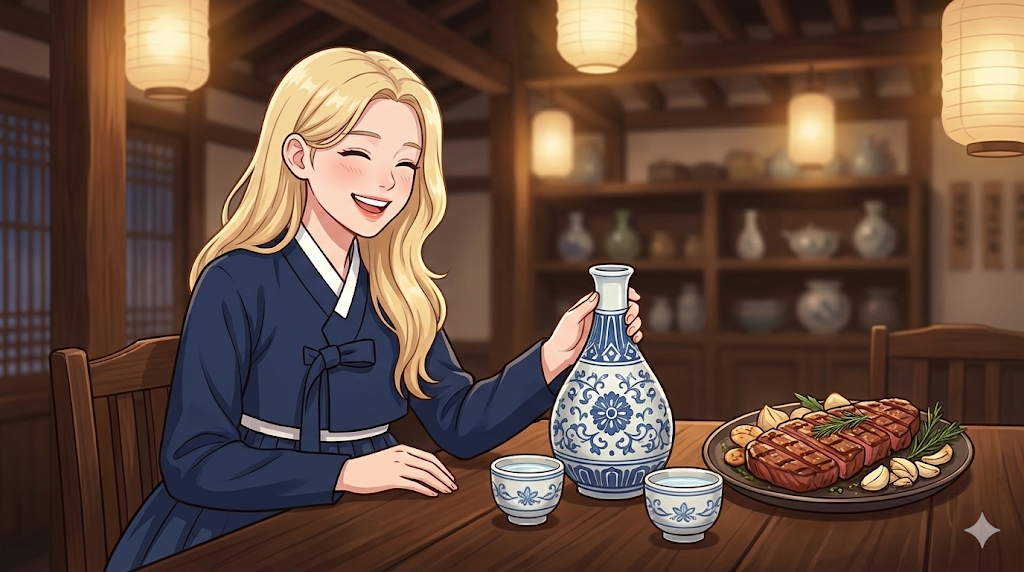
- Taste: Clean, powerful, and complex with deep rice aromas. Alcohol content is high (25-50%+).
- Perfect Pairing: Heavy, fatty meats like premium Samgyeopsal or Galbi.
Level 3: Ssam’s Insight (The Philosophy of “Anju”)
(Never drink alone)
Food and Alcohol are One
You might wonder, “Why do Koreans always order so much food with alcohol?” Fundamentally, in Korea, drinking without “Anju” (food paired with alcohol) is considered strange and unhealthy. Specifically, the goal of traditional drinking is social bonding and enjoying flavors, not just intoxication.
Therefore, the alcohol exists to enhance the food, and the food exists to balance the alcohol. Indeed, a true Korean master knows exactly which Anju matches which drink for the perfect harmony.

Alice’s Bottom Line: Shake Gently
The most important takeaway for a Traditional Korean Alcohol Guide beginner starts with Makgeolli. If you buy a bottle, remember that the rice sediment settles at the bottom. Therefore, don’t shake it violently like a cocktail! Just gently turn the bottle upside down a few times to mix it. Indeed, that creamy first sip will change your perception of Korean alcohol forever.
Survival Hangul: Alcohol Edition
- “막걸리 흔들어 주세요.”
- Pronunciation: (Mak-geol-li heun-deul-eo ju-se-yo)
- Meaning: Please shake the Makgeolli (gently) for me.
- “이거 도수가 얼마나 돼요?”
- Pronunciation: (I-geo do-su-ga eol-ma-na dwae-yo?)
- Meaning: What is the alcohol percentage (ABV) of this?
- “안주 추천해 주세요.”
- Pronunciation: (An-ju chu-cheon-hae ju-se-yo)
- Meaning: Please recommend an Anju (food pairing).