If you are looking for a dish that is spicy, silky, and incredibly comforting, look no further. Specifically, Soft Tofu Stew (Sundubu-jjigae) is the king of Korean stews. However, many beginners struggle because the tofu releases a lot of water, turning the stew into a bland soup.
Consequently, you need a specific strategy to keep the broth rich and fiery. In addition, the secret lies in creating the “Chili Oil” base before adding any liquid.
Welcome to Level 1. Let me tell you about the time I tried to use “Firm Tofu” for this stew and ended up with a brick soup.

Level 1: The “Tofu Texture” Disaster
Flashback: My first winter in Seoul.
Initially, I thought all tofu was the same. Therefore, I bought the hardest “Firm Tofu” from the supermarket, thinking it would hold its shape. Unfortunately, the result was not the silky, melt-in-your-mouth experience I expected.
Instead, the cubes of hard tofu stood there like soldiers, refusing to absorb the spicy broth. Furthermore, I added way too much water. Eventually, I had a giant pot of red water with floating white blocks. It was a complete failure. For this reason, I went to Ssam for the real secret.
Level 2: The Solution (The Flavor Base)
Immediately, Ssam pointed at the tube-shaped tofu. “Alice, you must use Soft Tofu (Sundubu). And remember: LESS water is more flavor.”
Here is the step-by-step Soft Tofu Stew Recipe that never fails.
Step 1: Creating the Chili Oil (The Foundation)
First, you must build the red flavor.
- Action: In a small pot (preferably a stone pot), sauté 1 tbsp of oil, 1 tbsp of sesame oil, and 2 tbsp of Korean chili powder (Gochugaru).
- Crucially: Keep the heat low. Otherwise, the chili powder will burn and taste bitter.
- Add: 100g of ground pork and 1 tbsp of minced garlic. Stir-fry until the pork is cooked.

Step 2: The “Minimum Water” Rule
Next, add the liquid.
- The Secret: Use only 100ml to 150ml of water (or kelp broth).
- Why: This seems like very little, but the soft tofu will release its own water as it heats up.
- Seasoning: Add 1 tbsp of soy sauce and a pinch of salt.
Step 3: Inserting the Silky Clouds
Subsequently, it is time for the star of the show.
- Technique: Cut the tofu tube in half and squeeze it into the boiling broth.
- Action: Break the tofu into large chunks with a spoon. Do not over-mash it!

Step 4: The Final Touch (The Egg)
Finally, bring it to a high boil.
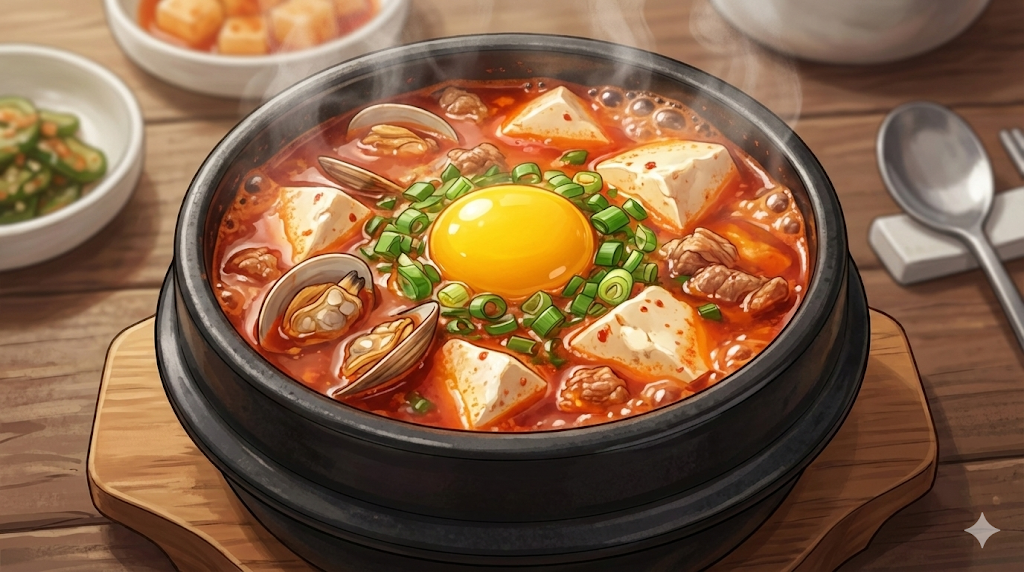
- The Highlight: Crack a raw egg into the center of the bubbling stew.
- Garnish: Top with plenty of chopped green onions and a sprinkle of black pepper.
- Serving: Serve it while it is still sizzling and “angry”!
Level 3: Ssam’s Gourmet Variations
Once you master the basic Soft Tofu Stew Recipe, try these upgrades:
- Seafood Style: Replace pork with clams, shrimp, and squid. It adds a clean, oceanic sweetness.
- Kimchi Style: Add half a cup of finely chopped sour Kimchi for extra tanginess.
- Mushroom Style: Use Enoki and Shiitake mushrooms for an earthy, vegetarian version.
Level 4: Deep Dive (Ssam’s Insight)
(Why the Stone Pot?)
The Ttukbaegi (Stone Pot) Magic
You might notice that Koreans always serve this in a black earthenware pot called Ttukbaegi. Fundamentally, this pot is made of porous clay. Because it retains heat extremely well, the stew keeps boiling even after you take it off the stove.
For this reason, your last bite will be as hot as your first. Indeed, this heat is what makes the raw egg cook perfectly inside the broth.
Alice’s Bottom Line: Respect the Ratio
The most important takeaway of this Soft Tofu Stew Recipe is the water ratio. If you use too much water, the silky texture of the tofu will be lost. Therefore, be brave and use less water than you think you need. Indeed, follow these steps, and you will have a restaurant-quality meal in 15 minutes.
Survival Hangul: Stew Edition
- “순두부찌개 하나 주세요.” * Pronunciation: (Sun-du-bu-jji-gae ha-na ju-se-yo)
- Meaning: Please give me one soft tofu stew.
- “계란 넣어주세요.” * Pronunciation: (Gye-ran neo-eo-ju-se-yo)
- Meaning: Please put an egg in.
- “뜨거워요!” * Pronunciation: (Tteu-geo-wo-yo!)
- Meaning: It’s hot!
Read This Next (Before You Make Another Mistake)
Full from the stew? Explore more flavors.