While Gangnam is famous for expensive luxury brands, the real fashion treasure actually lies beneath the ground. Specifically, I am talking about the Seoul underground shopping mall system.
These places are massive, cheap, and chaotic. However, they are not just shopping centers; they are complicated mazes designed to confuse you. For instance, the famous Goto Mall (Express Bus Terminal) is 880 meters long with over 600 stores.
If you go in without a plan, you will get lost. Furthermore, you might spend all your money on items you can’t even try on.
Welcome to Level 1. Let me explain how I entered the maze for a t-shirt and emerged with 20 pairs of socks.
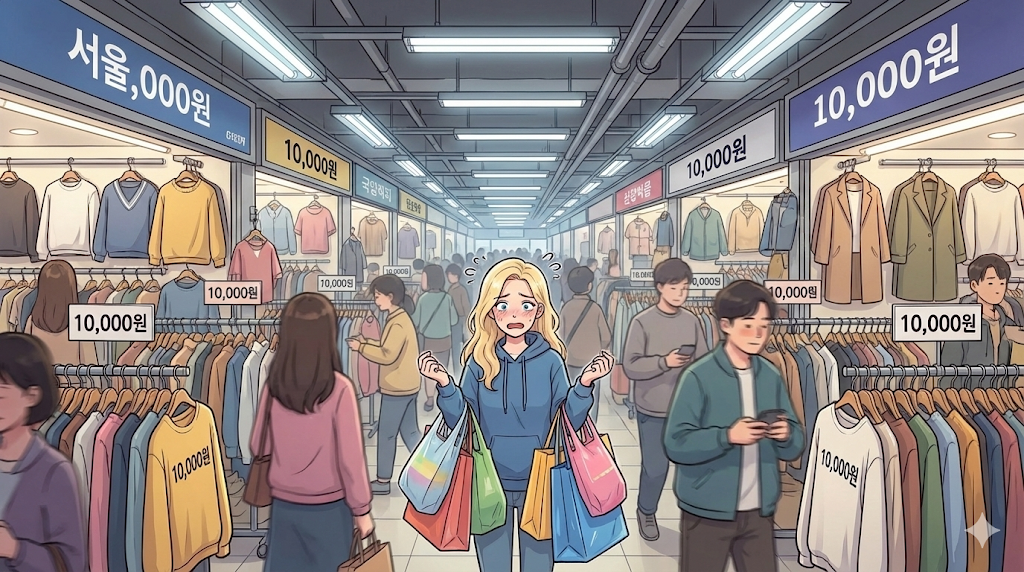
The Facepalm Files: The Cash Crisis
Flashback: 1 year ago. Goto Mall.
At first, I was excited. The prices were unbelievable. Jeans were $10, and sweaters were $5. Consequently, I went into a shopping frenzy. I picked out a beautiful dress and three shirts.
However, when I went to pay with my credit card, the shop owner made an “X” sign with her arms. She pointed to a small sign: “Cash Price. Card +10%.” Unfortunately, I had zero cash.
I had to leave my clothes behind and run to find an ATM. But because the mall is a maze, I couldn’t find the ATM. Eventually, when I found cash and came back, I couldn’t find the original store. I was lost in a sea of identical shops. As a result, I panic-bought 20 pairs of cute socks just to feel productive.
Enter “Ssam” (The Bargain Hunter)
I met Ssam later, carrying a bag full of socks. “Ssam, that place is a dungeon! Why do they hate cards?”
Ssam laughed at my sock collection. “Alice, the Seoul underground shopping mall has its own economy. Cash is King.”
Moreover, he explained the Golden Rules of the Underground: “The prices are cheap because the margins are low. Therefore, if you pay cash, they save on transaction fees and give you a discount. It is a win-win.”
Level 3 Wisdom: Rules of the Underground
Shopping here is different from a department store. Ideally, you should follow these three rules to survive.
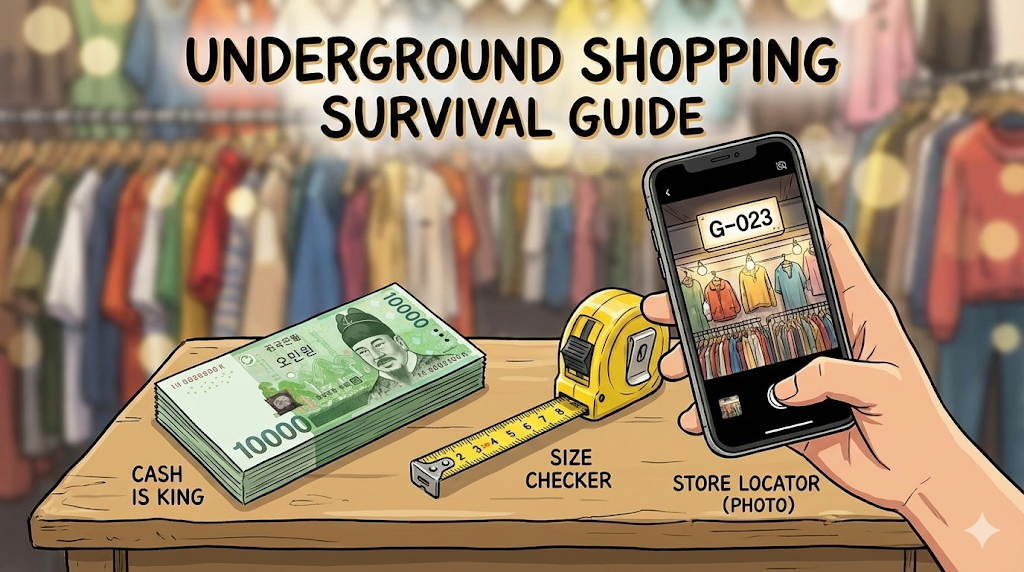
1. Bring Hard Cash (Hyun-geum)
Although most shops accept cards now, the price tag usually applies to Cash Payments.
- The Rule: If you use a card, they might add 10% VAT.
- The Strategy: Bring about 100,000 KRW ($80) in 10,000 won bills. You can buy a whole new wardrobe with this amount.
2. The “No Try-On” Policy
Unlike Zara or H&M, you usually cannot try on clothes here.
- Why? The clothes are cheap, and fitting rooms take up expensive space.
- Exceptions: Sometimes, you can try on coats or jackets over your clothes. However, white shirts and t-shirts are strictly forbidden (makeup stains).
- Tip: Know your measurements before you go.
3. Navigate by Numbers
Getting lost is easy. However, finding your way back is hard. Look at the ceiling. Every store has a section letter and number (e.g., G-023). Therefore, if you see a store you like but want to come back later, take a photo of the store number. Otherwise, you will never see it again.
Level 4: The Deep Dive (Ssam’s Insight)
(Why does Seoul have underground cities?)
The History Beneath Your Feet
You might wonder, “Why build malls underground?” Historically, this goes back to the tense relationship with North Korea.
1. Bunkers for Safety In the 1970s and 80s, Seoul expanded its subway system rapidly. Simultaneously, the government needed potential air-raid shelters in case of war. Consequently, large underground spaces were constructed.
2. Connecting the Traffic Seoul has terrible traffic jams. To solve this, the city built extensive underground passages to help pedestrians cross busy intersections safely. Over time, merchants moved into these empty tunnels. What started as small stalls evolved into the massive Seoul underground shopping mall networks we see today, like Goto Mall and Gangnam Station Underground.
In conclusion, you are not just shopping; you are walking through a piece of modern urban history.
Alice’s Bottom Line: Get Lost and Buy Socks
Goto Mall is intense, loud, and crowded. Nevertheless, it is the best place to see the latest K-Fashion trends for the price of a coffee.
Go with cash. Take photos of store numbers. Finally, if you get overwhelmed, just buy the cute socks. You can never have enough socks.
Survival Hangul: Shopping Terms
- “현금 얼마예요? (Hyeon-geum eolma-yeyo?)”
- Meaning: “How much is it in cash?” (This often lowers the price).
- “입어봐도 돼요? (Ib-eo-bwa-do dwae-yo?)”
- Meaning: “Can I try this on?” (The answer is usually No, but ask anyway).
- “깎아주세요. (Kkak-a-juseyo.)”
- Meaning: “Please give me a discount.” (Use this only if you buy a lot).
Read This Next (Before You Make Another Mistake)
Did you survive the shopping maze? Now explore more of Seoul.
- Legs hurt from walking 880 meters? Relax at a spa. [The Naked Truth: Korean Sauna Jimjilbang Guide]
- Need to check your bank balance? Use the WiFi. [Korean PC Bang Guide: Why It’s Actually a Ramen Restaurant]
- Hungry after shopping? Eat cheap and well. [Korean Convenience Store Food: The Ultimate $5 Feast Guide]