New York has rats, and Paris has smells. In contrast, the Seoul Subway has heated seats, 5G Wi-Fi, and arrival music. Consequently, it is arguably the best metro system in the world.
However, it is also a massive labyrinth. For instance, if you hop on the wrong train, you might end up in a different city instead of Gangnam. Specifically, the difference between “Express” (Geup-haeng) and “All-stop” (Il-ban) confuses every first-time visitor.
Therefore, you need this Seoul Subway guide to navigate the underground city like a local.
Level 1: The Rookie (The Line 9 Nightmare)
Flashback: 6 months ago. Gimpo Airport Station. Friday 6 PM.
Originally, I was supposed to meet my friends for dinner in Yeouido. I was feeling confident. “I’ve lived in New York. I can handle a subway,” I told myself.
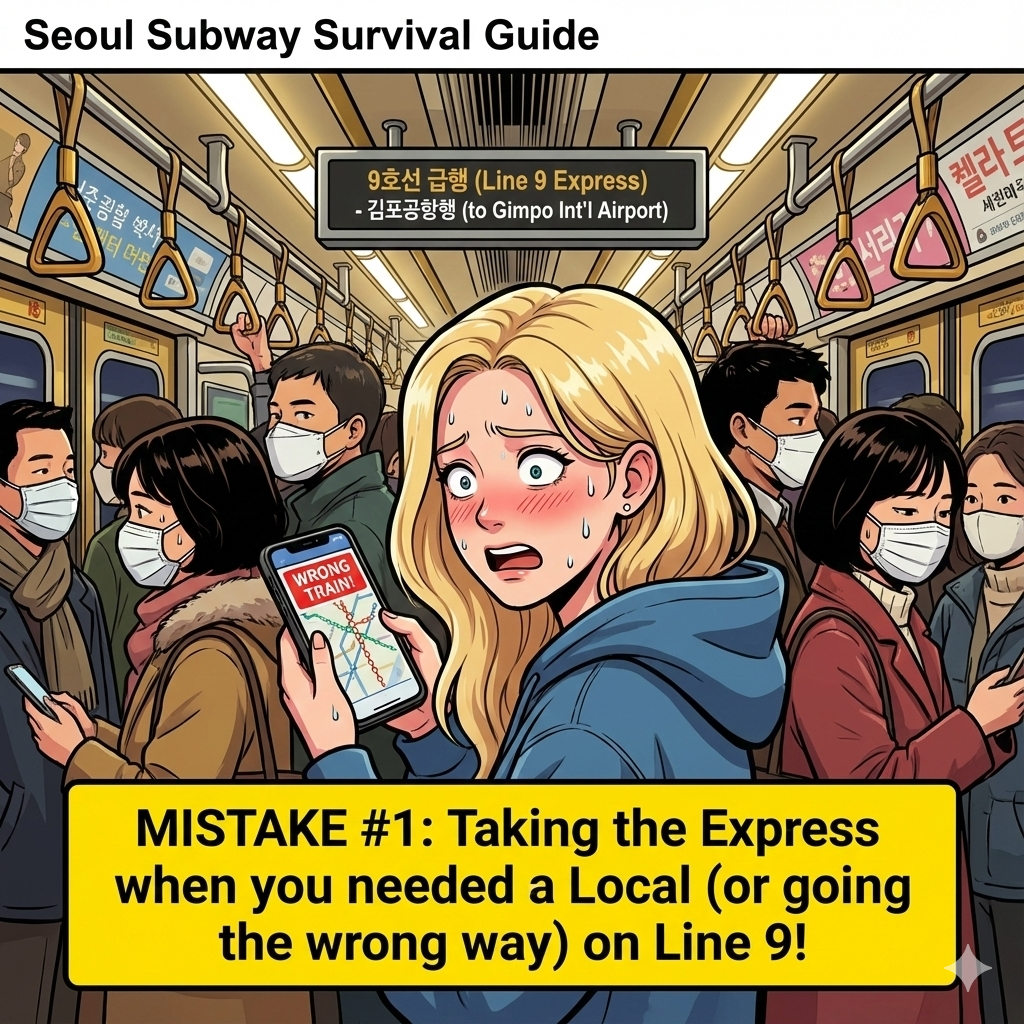
Upon arriving at the platform, I noticed a train approaching. Although it was packed like a sardine can, I saw people pushing their way in. Meanwhile, the digital sign on the train said something in Red Letters, but I foolishly ignored it. A train is a train, right? So, taking a deep breath, I squeezed my body between a businessman and a student, and eventually successfully boarded.
“Perfect,” I thought, checking my watch. “It’s only 5 stops. I’ll be there in 15 minutes.”
Suddenly, the train started moving. It was fast. In fact, it was terrifyingly fast. Then, the announcer’s voice came on: “This train does not stop at Magongnaru.” Confused, I frowned. ‘Wait, isn’t that the next station?’ Simultaneously, the train zoomed past the station platform at full speed. Whoosh.
Immediately, I started to sweat. Furthermore, it zoomed past the next one. And the next one. My heart began to race. Desperately, I tapped the shoulder of the student next to me.
“Excuse me! Yeouido? Does this stop at Yeouido?” The student looked at me with pity eyes. “No. This is Rapid. Express. The next stop is… far away.”
“Far away?!” Frantically, I looked at the digital map above the door. The lights were skipping 5, 6, 7 stations at a time. Helplessly, I watched my destination, Yeouido, disappear behind me. In that moment, I realized I was trapped in a metal bullet flying towards the wrong side of Seoul.
Enter “Ssam” (The Navigator)
Eventually, two hours later, I finally met Ssam at a cafe. I looked like I had just survived a war. My hair was messy, and I was holding a cold coffee like a lifeline.
“Alice! You’re an hour late!” Ssam exclaimed. “Did you get lost?”
In response, I slammed my head on the table. “Ssam, the subway kidnapped me. I swear. It just… refused to stop. Consequently, I ended up in Gangnam when I wanted to go to Yeouido. As a result, I had to take a $20 taxi back.”
Ssam burst out laughing. “Let me guess. Line 9? Red text?”
“Yes! The evil red text!” I cried.
“Alice, you fell into the classic tourist trap,” Ssam explained, opening his map app. “Specifically, that wasn’t a normal train. You took the ‘Geup-haeng’ (Express). It’s designed to skip stations to get people to work faster. Therefore, if your station isn’t a major hub, that train will treat you like a ghost and fly right past you.”
He tapped the screen. “You ignored the Red Light. Basically, in the subway, Red means Fast, but it also means Danger if you don’t know where you’re going.”
Level 2: The Pro (Pro Tips & Hacks)
Don’t let the train kidnap you. Ideally, follow these rules from my Seoul Subway guide.
1. Express vs. All-Stop (The Red Line)
First, some lines (especially Line 1 and Line 9) have two types of trains running on the same track.
- All-Stop (일반 – Ilban): Stops at every single station. While it takes longer, it is safe.
- Express (급행 – Geuphaeng): Skips minor stations. In contrast, it is very fast.
How to tell: Check the electronic board on the platform.
- Green/Black Text: All-stop.
- Red Text: Express.
- Audio: Make sure to listen for the word “Geup-haeng.”
2. Fast Transfer Numbers (Floor Markings)
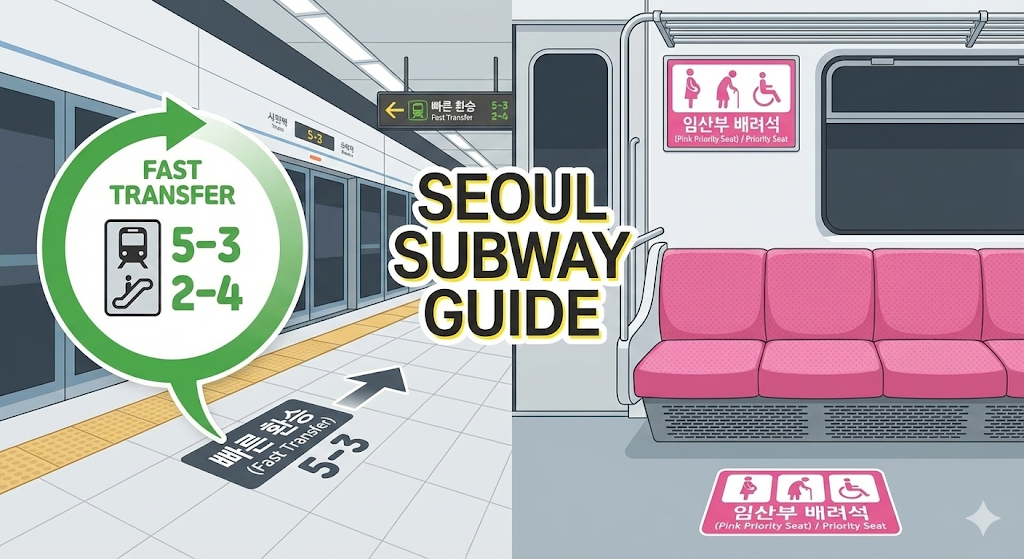
Next, look at the floor of the platform before you board. You will see numbers like “5-3” or “2-1”.
- Meaning: Car number 5, Door number 3.
- Why it matters: Your app (Naver Map) tells you the “Fastest Transfer Car” (e.g., “Transfer at 7-2”). If you stand there, the escalator will be right in front of you when the doors open. As a result, it saves 5 minutes of walking in the “Dungeon.”
3. The “Pink Seat” Rule
Finally, at the end of every car, there are seats covered in Pink fabric.
- Rule: These are exclusively for Pregnant Women.
- Etiquette: Even if the train is full and your legs are dying, do not sit there. Locals will stare at you. Moreover, regardless of whether you see a pregnant woman or not, keep it empty. It is a sacred rule of Seoul civic duty.
Level 3: The Ssam (Ssam’s Insight)
(Why is it so clean and safe?)
The “Civic Consciousness”
You might notice there are no trash cans on the platform, yet it is spotless. Moreover, you might see people leaving their bags on seats to go to the bathroom. Why? Fundamentally, it is the culture of “CCTV & Trust”.
- The Safety Bubble: Seoul has cameras everywhere. In addition, crime is extremely low. Consequently, the subway feels like an extension of one’s living room. People sleep without hugging their bags.
- The Order of the Queue: During Rush Hour (known as “Hell-chul”), it is chaos. However, notice the floor. People line up strictly behind the safety doors. In fact, pushing (mostly) happens only when getting on the train. It is organized chaos.
Level 4: The Map (Ssam’s Secret Map)
(Essential Links for Travelers)
Prepare your digital wallet and maps before you go underground.
📍 1. Subway Korea App (Best English Map)
Naver Map is great for navigation, but this app is best for seeing the whole map and timetable.
📍 2. T-Money Card Info (Official)
Everything you need to know about buying and refunding the transport card.
📍 3. WOWPASS (Cashless Travel)
Use this card for both subway and shopping.
- Get Card: WOWPASS Official Site
Alice’s Bottom Line: Look at the Floor
Seoul Subway is a game of numbers. Check the Train Type. Check the Door Number. Check the Pink Seat.
Master these, and you will travel faster than a taxi.
Survival Hangul: Subway Edition
- “급행이에요?” (Is this an Express train?)
- “이번 역이 어디예요?” (What station is this?)
- “갈아타는 곳” (Transferway sign)
Read This Next (Before You Make Another Mistake)
Mastered the subway? Now prepare the rest.