When I first arrived in Korea, I was scared of anything red. I survived on bread and plain rice. However, now I am a certified foodie who craves spicy soup at 2 AM.
Seoul is a delicious maze. Therefore, it is easy to get lost or fall into tourist traps (like expensive lobster tails). To help you navigate, I have compiled the ultimate Seoul food guide based on my “Facepalm” moments and Ssam’s expert advice.
Welcome to Level 3. Here are the 5 pillars of Korean cuisine you must experience before you leave.
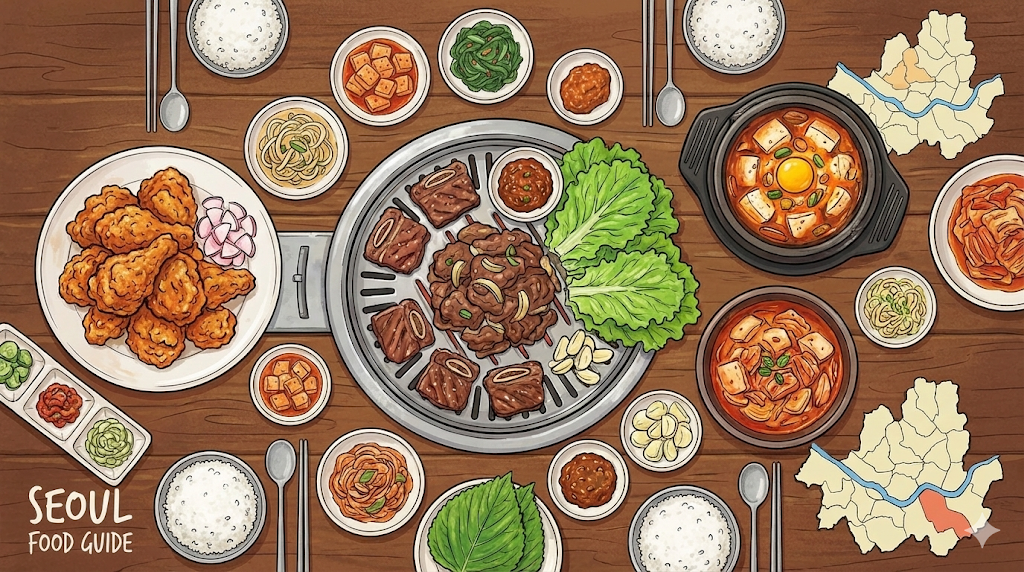
1. The Religion: Korean Fried Chicken (Chimaek)
In Korea, chicken is not just food; it is a lifestyle called Chimaek (Chicken + Beer).
- The Rule: Don’t just order “Fried.” You must try Yangnyeom (Spicy & Sweet) or Ganjang (Soy Garlic).
- The Hack: Can’t decide? Yell “Ban-Ban” (Half-Half).
- Ssam’s Tip: If you are on a date, order “Sun-sal” (Boneless) to avoid looking like a caveman.
[Read the full Chicken story here]
2. The Ritual: Korean BBQ (Samgyeopsal)
This is a strategic team sport. You don’t just eat; you build a Ssam (Wrap).
- The Mistake: I used to bite the lettuce wrap in half. The sauce exploded everywhere.
- The Fix: Put meat, garlic, and sauce in the leaf. Wrap it tight. Put the WHOLE thing in your mouth in one shot.
- The Hierarchy: Usually, the youngest person (Maknae) grills the meat. If you are a guest, just enjoy.
[Read the full BBQ guide here]
3. The History: Army Stew (Budae Jjigae)
At first, you might be shocked to see Spam, hot dogs, and baked beans in a spicy Korean soup.
- The Context: This dish was born after the Korean War using surplus food from US army bases.
- The Taste: It is the ultimate fusion. Spicy, savory, and rich.
- The Must-Do: You must add Ramyeon Sari (Instant Noodles) when the broth boils. It is non-negotiable.
[Read the full Army Stew story here]
4. The Street: Myeongdong Snacks
Myeongdong is chaotic, but it is the best place for street food—if you avoid the traps.
- Avoid: Grilled Lobster (Too expensive).
- Eat: Hotteok (Sweet Pancake), Egg Bread (Gyeran-ppang), and Kalguksu (Knife-cut noodles).
- Ssam’s Pick: Go to Myeongdong Kyoja for the best noodles and dumplings in the city.
[Read the full Myeongdong guide here]
5. The Budget: Convenience Store Feast
Broke? No problem. The Korean convenience store (CVS) is a Michelin restaurant for $5.
- The Magic: Look for 1+1 or 2+1 tags. It means free food.
- The Classic: Buy an Ice Cup + Pouch Drink. Then, cook a ramen in the silver machine.
- Vibe: Sitting on a plastic chair outside a CU at midnight is a core Seoul memory.
[Read the full CVS guide here]
Level 4: The Deep Dive (Ssam’s Insight)
(Why do Koreans share everything?)
The Culture of “Jeong” (Sharing)
In the West, you get your own plate. In this Seoul food guide, you will notice that Koreans share from one big pot. Why? It comes from the concept of “Jeong” (Affection/Bond).
1. One Pot, One Family Historically, eating from the same stew symbolized that we are family. Sharing saliva (indirectly) was a sign of closeness. (Don’t worry, these days we use ladles!)
2. Banchan (Side Dishes) You never pay for side dishes (Kimchi, spinach, bean sprouts). They are unlimited and shared by everyone at the table. This generosity is the heart of the Korean table.
Alice’s Bottom Line: Don’t Eat Alone
Korean food tastes better when it is loud, spicy, and shared. Grab a friend, order a “Ban-Ban,” and clink your glasses.
If you leave Seoul without gaining 3kg, you did it wrong.
Survival Hangul: Foodie Terms
- “맛집 (Mat-jib)”
- Meaning: “Delicious House.” (A popular restaurant).
- “배불러요 (Bae-bul-leo-yo)”
- Meaning: “I am full.”
- “잘 먹었습니다 (Jal meok-eot-seum-ni-da)”
- Meaning: “I ate well.” (Thank you for the meal).