Happy New Year! In Korea, January 1st is marked as a “Red Day” on the calendar, meaning it is a national public holiday. Specifically, while the Lunar New Year (Seollal) is the bigger traditional holiday, the Gregorian New Year on January 1st is equally important for a fresh start. However, if you think Koreans just stay home and sleep, you are mistaken.
Consequently, the streets are filled with people chasing the very first sun of the year. Fortunately, I have Ssam to guide me through the cold winter night to witness the most iconic Korean traditions.
Welcome to Level 1. Let me tell you about the time I tried to party all night and realized that Koreans take “waking up early” very seriously on this day.

Level 1: The “All-Nighter” Mistake
Flashback: My first December 31st in Seoul.
Initially, I thought the goal was to party until the sun came up in Gangnam or Hongdae. So, I stayed out dancing until 4:00 AM. Unfortunately, I realized that the real action was happening at the freezing cold mountains and beaches.
Instead of being in bed, half of Korea was already on a bus to the East Coast to see the sunrise. Furthermore, I missed the famous bell-tolling ceremony because I was too busy looking for a taxi. Eventually, I woke up at noon on January 1st, feeling like I had already lost the year. For this reason, I learned that you need to be “Pali-Pali” (fast) even on the first day of the year.
Level 2: Why is it a “Red Day” (Holiday)?
Immediately, I asked Ssam why we get a day off for the Gregorian New Year. “Alice, it’s a time to reset. It’s a national holiday so everyone can reflect on the past year and prepare for the new one,” Ssam explained.
Specifically, January 1st is a public holiday to:
- Mark the Start: Celebrate the first day of the solar calendar.
- Family Time: Give people time to visit family or attend local events.
- National Rest: Most offices and banks are closed, although many restaurants and malls in big cities remain open.

Level 3: What Do Koreans Do? (The Traditions)
Follow these steps to celebrate like a local:
1. Hearing the 33 Bell Tolls (Bosingak)
First, thousands gather at Bosingak Pavilion in Jongno, Seoul.
- The Ritual: The bell is struck exactly 33 times at midnight.
- Meaning: This originates from Buddhist traditions, wishing for national peace and prosperity.
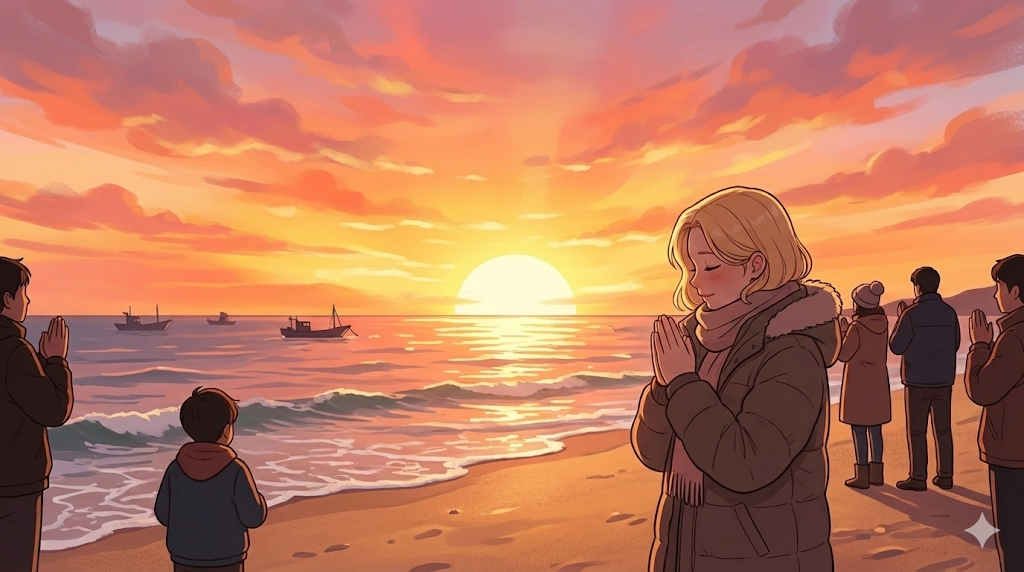
2. Chasing the First Sunrise
Next, many people travel to the East Coast, like Jeongdongjin Beach, or climb Namsan Mountain.
- The Goal: To see the first sun of the year peek over the horizon.
- The Wish: Koreans make a silent wish for health and luck as the sun rises. Indeed, it is a moving experience despite the freezing wind.
3. Eating Tteokguk (Rice Cake Soup)
Subsequently, you must eat a bowl of Tteokguk.
- The Symbolism: The white, oval rice cakes represent purity and wealth.
- The Joke: Koreans often say, “You only get one year older after you finish your bowl of Tteokguk.”
Level 4: Ssam’s Insight (The Two New Years)
(Why two holidays?)
Balance of Solar and Lunar
You might wonder, “Why does Korea have two New Year holidays?” Historically, Korea used the Lunar calendar for centuries. However, after adopting the Gregorian calendar for modern life, January 1st became the official start of the year.
Therefore, we have a “Modern New Year” (Jan 1) and a “Traditional New Year” (Seollal). Specifically, January 1st is more about resolutions and watching the sun with friends, while Seollal is about deep-bowing to elders and traditional rituals.
Alice’s Bottom Line: Wake Up Early!
The most important takeaway for New Year’s Day in Korea is to embrace the early morning. If you stay in bed, you miss the magical energy of the first sunrise. Therefore, bundle up in your warmest coat and find a hill or a beach. Indeed, the feeling of a new start under the cold Korean sky is unforgettable.
Survival Hangul: New Year Edition
- “새해 복 많이 받으세요!”
- Pronunciation: (Sae-hae bok ma-ni ba-deu-se-yo!)
- Meaning: Happy New Year! (Literally: Please receive a lot of luck in the new year!)
- “떡국 한 그릇 주세요.”
- Pronunciation: (Tteok-guk han geu-reut ju-se-yo)
- Meaning: Please give me a bowl of rice cake soup.
- “해돋이 보러 가요!”
- Pronunciation: (Hae-do-ji bo-reo ga-yo!)
- Meaning: Let’s go watch the sunrise!