If you live in Korea, you will eventually encounter a strange phenomenon: a friend’s birthday that moves every year. Specifically, Korea uses a “Dual Calendar” system. While the whole world follows the Solar (Gregorian) calendar, Korea maintains a deep connection with the Lunar calendar for traditions.
Consequently, if you don’t understand this system, you might miss the biggest holidays of the year. Fortunately, I have Ssam to explain why my calendar has so many “small numbers” written next to the big ones.
Welcome to Level 1. Let me tell you about the time I thought I was losing my mind because my friend celebrated her birthday twice in one year.
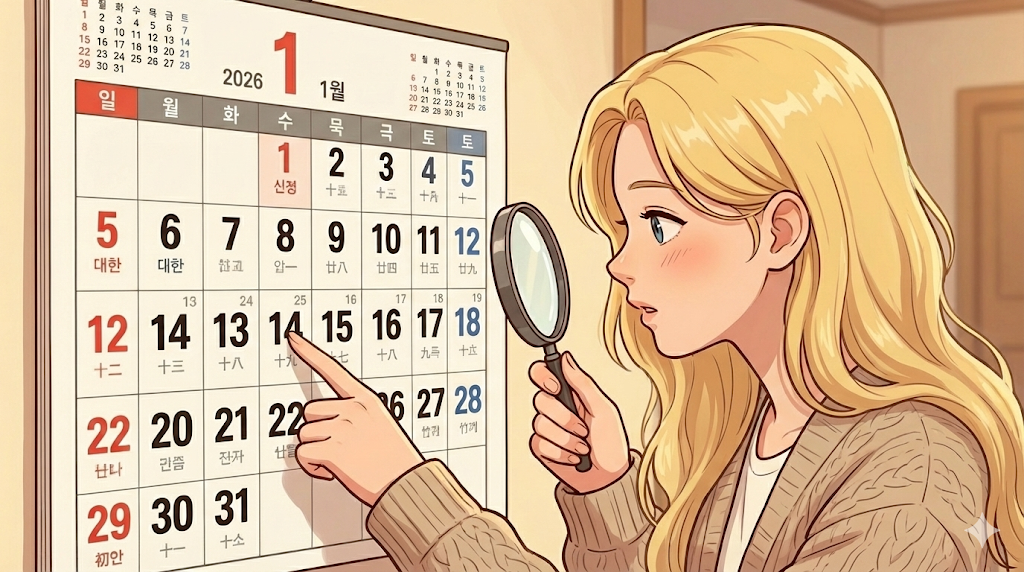
Level 1: The “Moving Birthday” Mystery
Flashback: Checking my digital planner.
Initially, I recorded my Korean friend’s birthday as February 10th. So, the next year, I prepared a gift and sent a message on February 10th. Unfortunately, she replied, “Oh, my birthday is actually next week this year!”
Instead of a fixed date, her family followed the Lunar calendar. Furthermore, I realized that the Lunar New Year (Seollal) and the Harvest Festival (Chuseok) also jumped around the calendar like crazy. Eventually, I felt like I was living in a time-travel movie. For this reason, I sat down with Ssam to learn the “Science of the Moon.”
Level 2: The Difference (Yang-nyeok vs. Eum-nyeok)
Immediately, Ssam drew two circles on a piece of paper: the Sun and the Moon. “Alice, we call the Solar calendar Yang-nyeok (Yang = Sun) and the Lunar calendar Eum-nyeok (Eum = Moon),” he explained.
Specifically, here is how they work in modern Korea:
- Yang-nyeok (Solar): Used for official business, school schedules, and modern life.
- Eum-nyeok (Lunar): Used for traditional holidays, ancestral rites, and many elderly people’s birthdays.

Level 3: Why Do We Still Use the Moon?
You might wonder, “Why not just use one calendar like everyone else?” Historically, the Lunar calendar was the “Farmer’s Bible.” Because Korea was an agricultural society, the phases of the moon and the 24 solar terms were essential for planting and harvesting.
Therefore, the most important emotional events are still tied to the moon:
- Seollal (Lunar New Year): The 1st day of the 1st lunar month.
- Chuseok (Harvest Festival): The 15th day of the 8th lunar month (The biggest full moon).
- Daeboreum: The first full moon of the year.
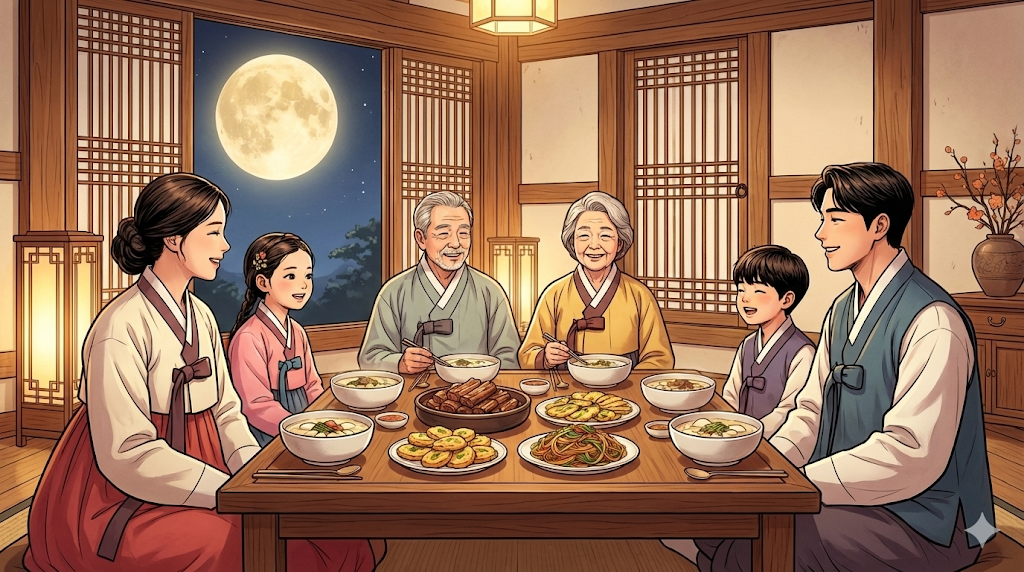
Level 4: Ssam’s Insight (Modern Korea’s Choice)
(Which one should you follow?)
The Generational Shift
Specifically, most younger Koreans (Millennials and Gen Z) now use the Solar calendar for their birthdays. However, they still have to “calculate” their parents’ or grandparents’ birthdays every year.
For this reason, many Korean calendar apps have a “Lunar Conversion” feature built-in. Consequently, even if the moon is complicated, technology helps us stay on track. Indeed, the coexistence of these two calendars shows how Korea respects its roots while racing toward the future.

Alice’s Bottom Line: Look for the Small Numbers
The most important takeaway for the Lunar vs Solar Calendar in Korea is to check your physical calendar. If you see tiny numbers next to the big ones, those are the lunar dates. Therefore, if a Korean friend says their birthday is “moving,” don’t panic. Indeed, just ask them, “Is it Solar or Lunar?” and they will think you are a total Korea expert!
Survival Hangul: Calendar Edition
- “양력이에요, 음력이에요?”
- Pronunciation: (Yang-nyeok-i-e-yo, eum-nyeok-i-e-yo?)
- Meaning: Is it Solar or Lunar?
- “올해 추석이 언제예요?”
- Pronunciation: (Ol-hae Chu-seok-i eon-je-ye-yo?)
- Meaning: When is Chuseok this year?
- “생일이 바뀌었어요.”
- Pronunciation: (Saeng-il-i ba-kwi-eot-seo-yo)
- Meaning: My birthday has changed (moved).
