When you think of Korean music, K-Pop probably comes to mind first. However, the true DNA of those catchy rhythms lies in Gugak (Traditional Korean Music). Specifically, Gugak is a genre that captures the two core emotions of Korea: Han (deep sorrow) and Heung (joyful energy).
Consequently, listening to Gugak is like listening to the heartbeat of the country. Fortunately, I have Ssam to explain why the “silence” between the notes is just as important as the sound itself.
Welcome to Level 1. Let me tell you about the time I went to a Gugak concert expecting a nap, but ended up shouting “Eol-ssigu!” at the top of my lungs.
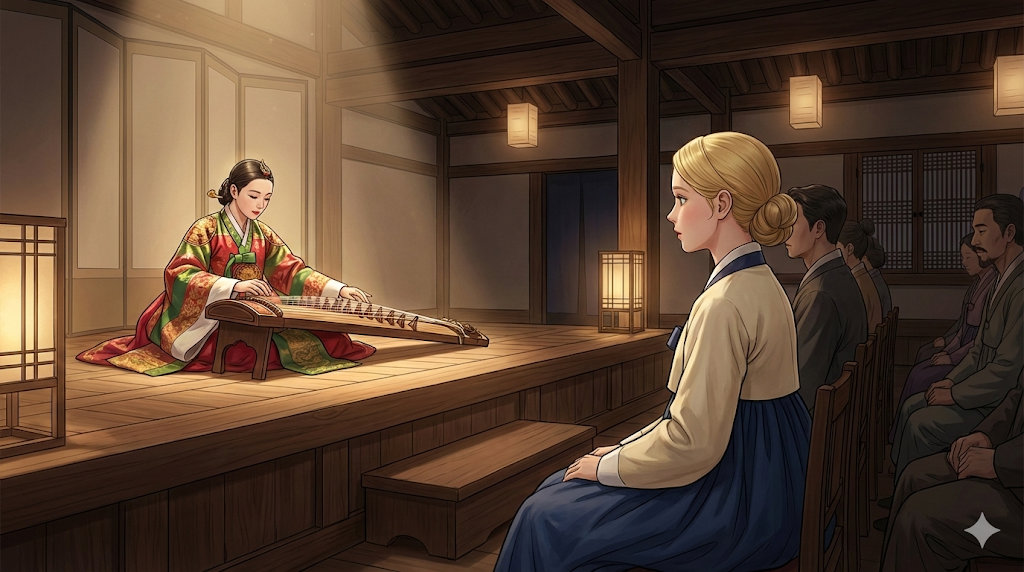
Level 1: The “No Drum” Confusion
Flashback: My first visit to the National Gugak Center.
Initially, I was confused by the lack of a constant, heavy beat. So, I whispered to Ssam, “Where is the bass? How do people know when to clap?” Unfortunately, I was trying to listen to Gugak with “Western ears.”
Instead of a mechanical metronome, I realized that the rhythm follows the human breath. Eventually, when the singer (Sorikkun) started their Pansori (storytelling song), the raw power of their voice made the hair on my arms stand up. For this reason, I learned that Gugak is not meant to be background music; it is an emotional conversation between the performer and the audience.
Level 2: The Two Faces of Gugak
Immediately, Ssam divided the music into two main vibes. “It’s like the difference between a royal gala and a street party,” he said.
1. Jeongak (The Royal Court Music)
Specifically, this was the music for kings and scholars.
- The Vibe: Slow, meditative, and incredibly calm.
- Experience: It feels like the Korean Tea Ceremony in sound form. Indeed, it is designed to help you reach a state of inner peace.
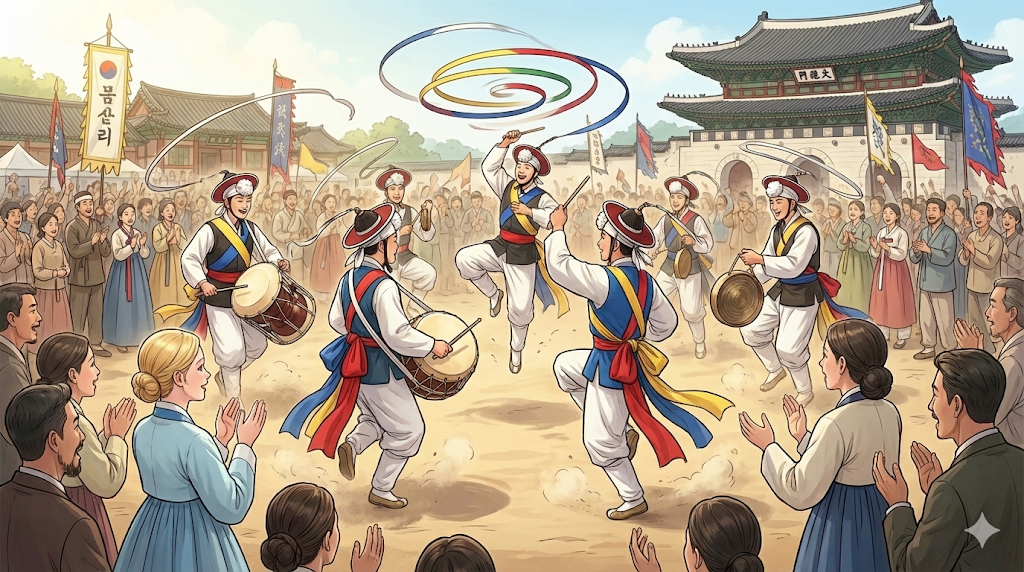
2. Minsogak (The Music of the People)
On the other hand, this is the energetic music of the common people.
- Examples: Pansori (one singer, one drummer) and Samulnori (four percussion instruments).
- Energy: It’s loud, fast, and highly improvisational. Consequently, you are encouraged to shout “Chu-im-sae” (encouraging words) during the performance!
Level 3: Gugak in 2026 (The Crossover)
(Is it still “Old” music?)
The New K-Sound
You might wonder, “Do young people still listen to this?” Actually, in 2026, Gugak is the “secret sauce” of modern K-culture. Specifically, you can hear it in:
- K-Pop Hits: Many groups use the Piri (flute) or KKwaenggwari (gong) to create unique, viral sounds.
- Game Soundtracks: Massive online games now feature orchestral Gugak to create epic, historical vibes.
Therefore, Gugak is not a dead tradition; it is a living, breathing part of the global music scene. Indeed, the fusion of ancient instruments with 6G technology is creating a “Neo-Gugak” wave in Seoul.
Alice’s Bottom Line: Listen to the “In-between”
The most important takeaway for the Korean Traditional Music Gugak guide is to listen for the “Simgong” (vibration of the heart). If you find a performance in Insa-dong or Bukchon, don’t just record it on your phone. Therefore, close your eyes, feel the rhythm of the breath, and don’t be afraid to shout “Jota!” (Great!) when you feel the energy. Indeed, once you catch the “Heung,” you’ll never hear music the same way again.
Survival Hangul: Music Edition
- “얼씨구! / 좋다!”
- Pronunciation: (Eol-ssi-gu! / Jo-ta!)
- Meaning: Wow! / Great! (Standard Chu-im-sae to encourage performers).
- “가야금 소리가 예뻐요.”
- Pronunciation: (Ga-ya-geum so-ri-ga ye-ppeo-yo)
- Meaning: The sound of the Gayageum is beautiful.
- “공연 언제 시작해요?”
- Pronunciation: (Gong-yeon eon-je si-jak-hae-yo?)
- Meaning: When does the performance start?
Read This Next (Recommended for You)
- Want to see where the music of the people truly lives? [Traditional Korean Market Food Tour: Must-Eat Street Food Guide]
- Looking for a quick snack after the performance? [Korean Convenience Store Guide: The $1 Gourmet Heaven]
- Wondering how these ancient sounds fit into a high-tech city? [Is South Korea Living in the Future? 5 Reasons It Feels Like 2077]