In the high-tech world of 2026, where 3D printing is common, there is a growing desire for things made slowly by hand. Specifically, Korean Traditional Crafts are not just about making objects; they are about the relationship between the artisan and the natural materials. However, if you try to apply the “Pali-Pali” (Hurry-Hurry) spirit to these crafts, you will quickly learn a lesson in patience.
Consequently, the most beautiful part of K-Art is the “Beauty of Imperfection” that comes from human touch. Fortunately, I have Ssam to guide me through the delicate world of shells, paper, and silk.
Welcome to Level 1. Let me tell you about the time I tried to finish a 1,000-year-old lacquerware technique in 15 minutes.
Level 1: The “Sticky Finger” Disaster
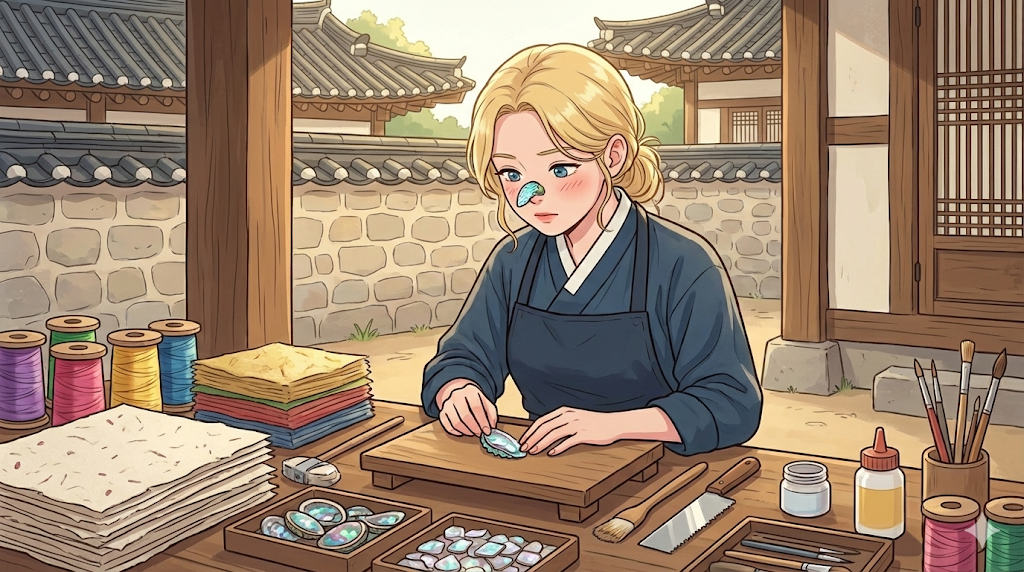
Flashback: My first Najeon-chilgi (Mother-of-Pearl) workshop.
Initially, I looked at the tiny, shimmering pieces of abalone shell and thought, “I can just glue these on like stickers.” So, I applied a huge amount of adhesive and tried to rush the design. Unfortunately, the shell pieces started sliding around, and my fingers became permanently bonded to a small wooden box.
Instead of a masterpiece, I created a sticky mess. Eventually, the master artisan chuckled and said, “Alice, the shell needs time to find its home on the wood.” For this reason, I learned that the Korean Traditional Crafts Guide is actually a test of your soul’s stillness.
Level 2: The Solution (Three Pillars of K-Craft)
Immediately, Ssam introduced me to the three most popular crafts for beginners in Seoul. “Each material has its own personality,” he explained.
1. Najeon-chilgi (Mother-of-Pearl)
The art of inlaying shimmering sea shells into lacquerware.
- The Magic: It changes color depending on the angle of the light.
- Experience: It feels like you are capturing a piece of the ocean in a box. Indeed, it is the most luxurious souvenir you can make.
2. Hanji (Mulberry Paper Art)
Traditional paper made from the bark of mulberry trees.
- The Strength: There is a saying that “Hanji lasts a thousand years.”
- Action: You can make anything from lamps to sturdy storage boxes. Consequently, the soft glow of a Hanji lamp is the ultimate “healing” interior item.
3. Bojagi (Wrapping Cloth)
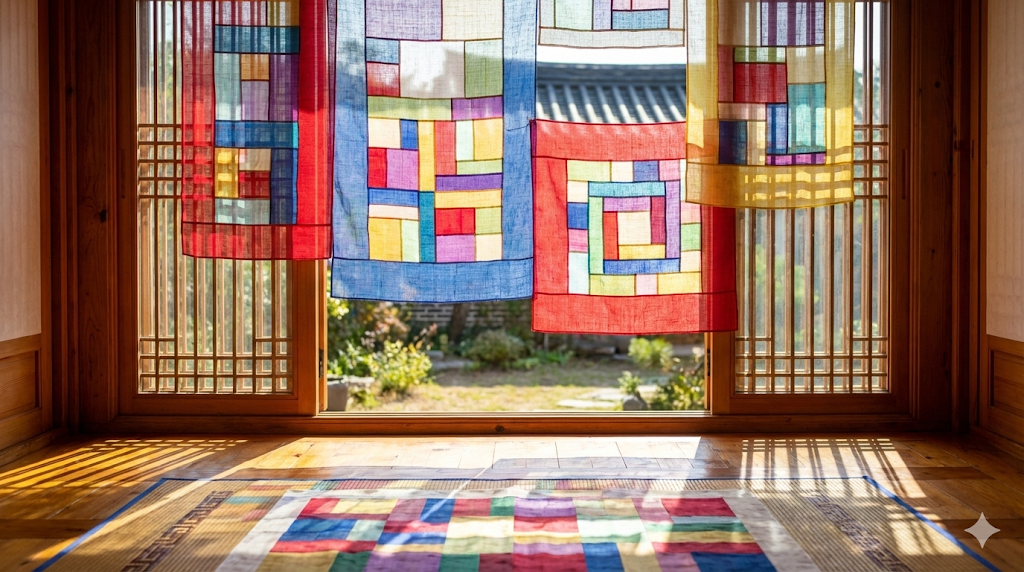
The art of sewing small scraps of silk together to make a wrapping cloth.
- The Philosophy: It represents the act of “wrapping luck.”
- Aesthetic: Modern Bojagi is often compared to Mondrian’s paintings because of its beautiful geometric patterns.
Level 3: Ssam’s Insight (Crafts in 2026)
(Tradition meets Gen-Z)
The New Luxury
You might wonder, “Are these crafts only for older people?” Actually, in 2026, “New-tro” (New + Retro) is the biggest trend. Specifically, young Koreans are applying traditional patterns to modern tech:
- Najeon phone cases and Bojagi laptop sleeves.
- Hanji diffusers for smart homes.
Therefore, these crafts are a way to make the digital world feel more human and warm. Indeed, owning something handmade is now the ultimate symbol of taste and luxury in Seoul.
Alice’s Bottom Line: Follow the Rhythm of the Material
The most important takeaway for the Korean Traditional Crafts Guide is to respect the material. If the wood is hard or the silk is slippery, don’t fight it. Therefore, listen to the artisan, breathe deeply, and enjoy the slow process. Indeed, you will leave not just with a souvenir, but with a calmer heart.
Survival Hangul: Craft Workshop Edition
- “이거 제가 직접 만든 거예요.”
- Pronunciation: (I-geo je-ga jik-jeop man-deun geo-ye-yo)
- Meaning: I made this myself.
- “너무 예뻐요!”
- Pronunciation: (Neo-mu ye-ppeo-yo!)
- Meaning: It’s so beautiful!
- “조금 더 도와주세요.”
- Pronunciation: (Jo-geum deo do-wa-ju-se-yo)
- Meaning: Please help me a little more.
Read This Next (Recommended for You)
- Want to find a beautiful cup for your tea? [Traditional Korean Alcohol Guide: Beyond the Green Bottle]
- Looking for the best place to buy craft materials? [Traditional Korean Market Food Tour: Must-Eat Street Food Guide]
- Contrast the handmade with the high-tech: [Korean Convenience Store Guide: The $1 Gourmet Heaven]