
In America, Spam is… well, it’s mystery meat. It’s emergency food you keep in your basement for the apocalypse. In Korea, Spam is a luxury gift set given during holidays.
And the most popular way to eat it? Boiling it in a spicy red broth with kimchi, baked beans, tofu, and ramen noodles. It sounds like a chaotic fridge experiment gone wrong. It is called Budae Jjigae (Army Stew).
But before you laugh at the ingredients, you need to know the story. This isn’t just a stew. It is a bowl of Korean history.
Welcome to Level 1. Let me tell you about the time I refused to eat “Spam Soup” and offended my coworkers.
The Level 1 Logs: The Spam Shock
Flashback: 3 years ago. Lunch in Uijeongbu.
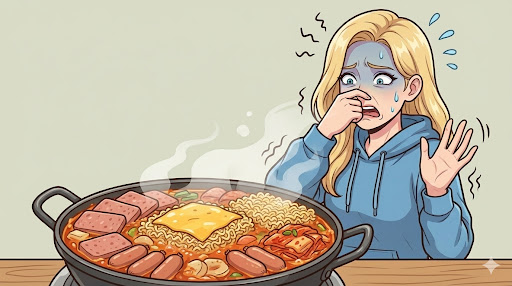
My coworkers took me to a famous restaurant. “Alice, today we eat special stew!” they said excitedly. The pot arrived. I looked inside. Hot dogs. Spam. Baked beans. Macaroni. And… Kimchi? It looked like someone raided an American pantry and dumped it into a Korean soup.
I whispered, “Is this… garbage?” I poked a piece of soggy Spam with my chopsticks. “I can’t eat this. Processed meat should be fried, not boiled!” I stuck to eating plain rice. My coworkers looked disappointed. I thought they were crazy for loving this “junk food soup.”
Enter “Ssam” (The Historian)
I complained to Ssam later. “Ssam, why do Koreans ruin Kimchi stew with hot dogs? It tastes cheap.”
Ssam stopped smiling. “Alice, it tastes cheap because it had to be cheap. That stew saved people from starving.”
He explained the meaning of “Budae”: “Budae means ‘Military Unit.’ This is the stew from the US Army bases.”
Level 3 Wisdom: How to Enjoy the Chaos
Before we get to the heavy history, let’s learn how to eat it properly. Because honestly? It IS delicious once you get over the Spam prejudice.
1. The Ramen Rule (Ramyeon Sari)
Budae Jjigae is incomplete without Instant Noodles (Ramyeon Sari).
- Timing: Put the noodles in when the broth is boiling hard.
- Texture: Eat them before they get soggy. The noodles absorb the ham and kimchi flavor. It is the best part.
2. The Broth Management (Yuksu)
As you boil the stew, the salty ham and cheese make the soup thick and salty.
- The Fix: Shout “Yuksu juseyo!” (More broth, please). The waiter will pour a kettle of plain broth to balance the flavor.
3. Rice is Mandatory
You don’t just eat the stew. You mix the ham, sausage, and soup with your white rice. The salty, spicy, greasy combo is the ultimate comfort food.
Level 4: The Deep Dive (Ssam’s Insight)
(Why is this food meaningful?)
The Sadness Behind the Spam
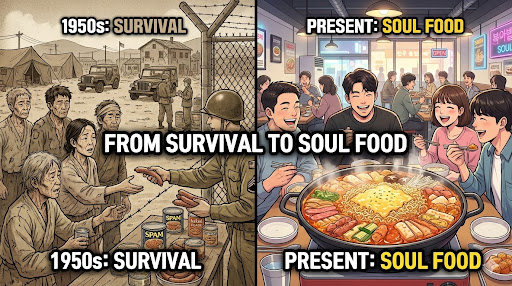
1. The Ruins of War (1950s) After the Korean War, the country was devastated. There was no food. People were starving. The only place with plenty of food was the US Military Bases.
2. Johnson Tang (The Original Name) Koreans living near the bases (like in Uijeongbu) managed to get leftover canned food from American soldiers—Spam, sausages, baked beans. But these ingredients were too greasy and salty for Koreans. So, they washed them, threw them into a pot with Kimchi, Gochujang (Chili paste), and water to make a large stew that could feed a whole family. Sometimes it was called “Johnson Tang” (named after US President LBJ).
3. From Survival to Soul Food Today, Korea is rich. We can afford fresh meat. But Budae Jjigae remains. It transformed from a symbol of poverty into a symbol of resilience. It represents how Korea took something foreign and tragic, and turned it into something uniquely Korean and delicious.
So when you eat that slice of Spam, you are tasting the history of modern Korea.
Alice’s Bottom Line: Don’t Judge the Pot
It looks messy. It sounds weird. But the moment you taste that spicy, savory broth infused with melted cheese and ham? You will understand.
It is the ultimate fusion food. American ingredients, Korean soul. Just don’t tell my mom I’m eating boiled Spam.
Survival Hangul: At the Restaurant
- “라면사리 추가해 주세요. (Ramyeon-sari chuga-hae juseyo.)”
- Meaning: “Please add instant noodles.”
- “육수 더 주세요. (Yuksu deo juseyo.)”
- Meaning: “More broth, please.” (When it gets too salty).
- “앞치마 주세요. (Ap-chi-ma juseyo.)”
- Meaning: “Give me an apron.” (The red soup splashes everywhere).
Read This Next (Before You Make Another Mistake)
Now that you’ve tasted history, explore more of Korea.