If you look at the skyline of any South Korean city, you won’t see many red-brick houses. Instead, you will see towering forests of concrete buildings. Specifically, Korean Apartment Culture represents the most desired way of living in 2026, offering a level of convenience that feels straight out of a sci-fi movie.
However, for those used to backyard gardens and physical keys, life in a high-rise “Vertical City” requires a bit of an adjustment.
Welcome to Level 1. Let me tell you about the time I stood in front of my new apartment for 5 minutes, looking for a keyhole that didn’t exist.

Level 1: The “Keyless” Confusion
Flashback: My first day moving into a Seoul apartment.
Initially, I reached into my pocket to find the metal key my landlord “gave” me. But then I realized he didn’t give me a key; he gave me a 4-digit code. Unfortunately, I spent several minutes looking for a hidden keyhole behind the handle.
Eventually, a neighbor walked by, tapped a sleek black screen on their door, and disappeared inside after a melodic “beep-beep-beep-ri-ring!” For this reason, I learned that in Korean Apartment Culture, physical keys are relics of the past. Everything is digital, from the main gate to your front door.
Level 2: The Solution (Why Everyone Wants to Live Here)
Immediately, I asked Ssam why apartments are so much more expensive than houses. “Alice, it’s not just a house; it’s a service package,” he explained.
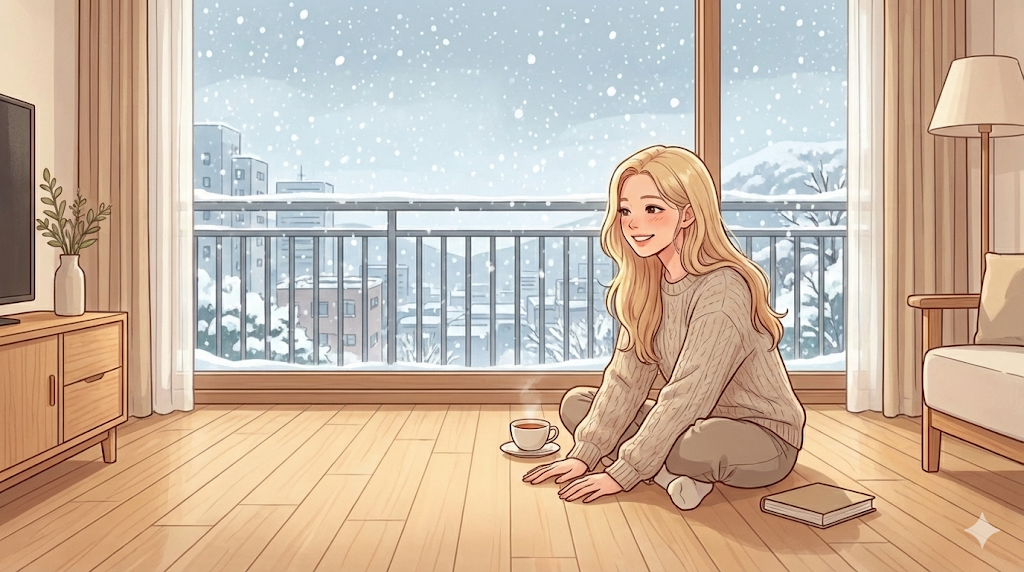
1. The Magic of Ondol (Floor Heating)
First, you won’t find noisy air vents in a Korean apartment.
- The Secret: The entire floor is heated from underneath.
- Experience: Walking barefoot on a warm floor in the middle of winter is a spiritual experience. Indeed, it’s why Koreans love sitting and sleeping on the floor.
2. The “Smart” Infrastructure
Next, the convenience is unmatched.
- Features: Built-in systems for food waste disposal, touch-screen wall pads to call elevators, and dedicated “Delivery Zones” for the thousands of packages arriving daily.
Level 3: The Rules of the “Vertical Tribe”
(Living together, separately)
The Recycling Masterclass
You might wonder, “How do thousands of people live in one building without a mess?” Fundamentally, it’s because of strict social rules. Specifically, the recycling system is legendary.
Therefore, every Sunday night (or a designated day), you will see residents meticulously separating plastic, paper, glass, and vinyl. Moreover, “Floor Noise” (Cheung-gan-so-eum) is a serious social issue. Consequently, most people wear soft slippers at home to avoid disturbing the “tribe” living directly below them.
Level 4: Ssam’s Insight (The Community Center)
In 2026, modern apartments are essentially resorts. Specifically, new complexes come with “Community Centers” that include:
- Gyms and Indoor Golf: No need for a separate membership.
- Cafes and Libraries: Places to work or study (Cagong style!) without leaving the building.
- Breakfast Services: Some high-end apartments even serve hotel-style breakfast to residents.

Alice’s Bottom Line: It’s an Efficient Paradise
While I sometimes miss having a private garden, Korean Apartment Culture offers a lifestyle of maximum efficiency. If you love warm floors, high security, and having a gym just 2 minutes away, you will never want to live anywhere else. Indeed, once you get used to the “Beep-Ring” of your digital lock, you’ll feel like you’ve truly arrived in the future.
Survival Hangul: Apartment Edition
- “비밀번호가 뭐예요?”
- Pronunciation: (Bi-mil-beon-ho-ga mwo-ye-yo?)
- Meaning: What is the (door) passcode?
- “분리수거 언제 해요?”
- Pronunciation: (Bun-li-su-geo eon-je hae-yo?)
- Meaning: When is the recycling day?
- “층간소음 조심해 주세요.”
- Pronunciation: (Cheung-gan-so-eum jo-sim-hae ju-se-yo)
- Meaning: Please be careful with the noise between floors.
Read This Next (Recommended for You)
- Now that you’re home, let’s go have some fun! [Everland Theme Park Guide: T-Express & Panda Tips]
- Want to know why your move-in date was so important? [Lunar vs Solar Calendar in Korea: Why Birthdays Change]
- Start a fresh day in your new home with a lucky bowl: [New Year’s Day in Korea: Why It’s a Holiday & What to Do]