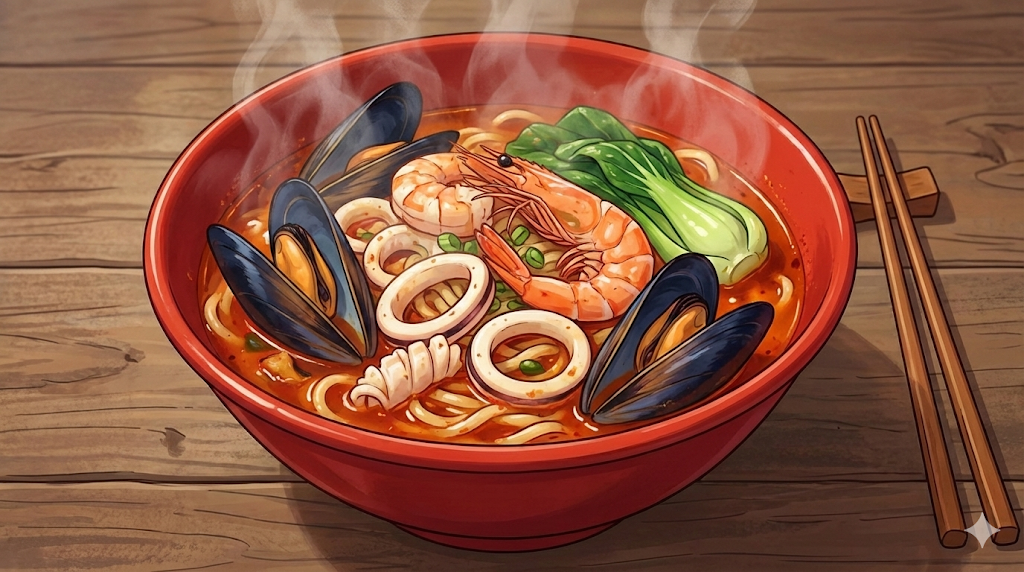
If Jajangmyeon is the “comfort king” of moving day, Jjamppong and Tangsuyuk are the exciting rivals that complete the holy trinity of Korean Chinese Cuisine. Specifically, Jjamppong is a fiery seafood noodle soup, while Tangsuyuk is the crispy, sweet and sour pork that everyone loves to share. However, ordering these dishes comes with a set of social rules and high-stakes debates that might surprise you.
Consequently, you need a strategy to survive the spice and the “sauce etiquette.” Fortunately, I have Ssam to explain why Koreans take “Pouring vs. Dipping” so seriously.
Welcome to Level 1. Let me tell you about the time I accidentally poured the sauce over the entire plate of Tangsuyuk and the whole table went silent for 3 seconds!
Level 1: The “Jjam-Jja” Dilemma
Flashback: My first office lunch at a Chinese restaurant.
Initially, I couldn’t decide between the sweet black bean sauce and the spicy seafood broth. So, I spent 5 minutes looking at the menu. Unfortunately, I didn’t know about the Jjamjjamyeon—the legendary split bowl that gives you both!
Instead of choosing, I followed Ssam’s lead and ordered a fiery Jjamppong. Eventually, the first sip of the red broth made me realize why it’s the ultimate “stress-reliever” for Koreans. For this reason, I learned that Jjamppong isn’t just a soup; it’s an emotional experience that clears your sinuses and your mind.
Level 2: The Solution (The Great Sauce Debate)
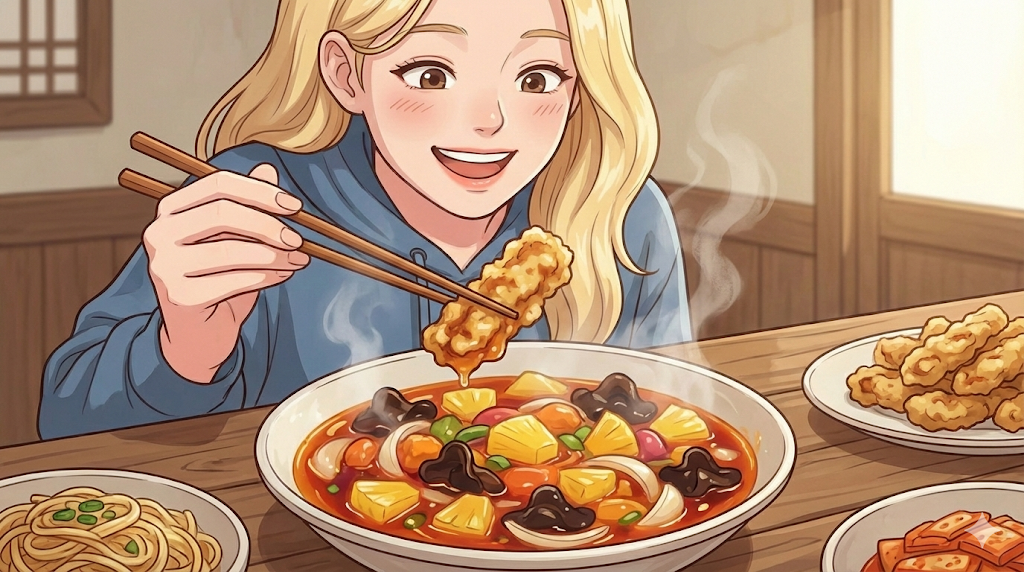
Immediately, when the Tangsuyuk (sweet and sour pork) arrived, the real tension started. “Alice, wait! Are you a ‘Bumuk’ (Pourer) or a ‘Jjamuk’ (Dipper)?” Ssam asked seriously.
1. The Etiquette of Tangsuyuk
- Bumuk (Pourer): Pouring the sauce over the pork. It makes the meat soft and juicy.
- Jjamuk (Dipper): Dipping the dry meat into the sauce. It keeps the pork perfectly crispy.
- Note: Indeed, this is the most famous food debate in Korea. Always ask before you pour, or you might start a small war!
2. The Jjamppong Varieties
Next, Jjamppong has evolved in 2026.
- Go-gi Jjamppong: A heavy, meaty version with beef or pork.
- Haemul Jjamppong: The classic, light, and refreshing seafood version.
Level 3: Ssam’s Insight (The 2026 K-Chinese Trend)
(Beyond the Basics)
Gourmet Evolution
You might wonder, “Is it just cheap takeout food?” Fundamentally, no. Specifically, in 2026, many restaurants are using premium ingredients like truffle oil or grilled abalone.
Therefore, these dishes have moved into the “Fine Dining” world. Moreover, the combination of “Tang-Jja-Jjam” (Tangsuyuk + Jajangmyeon + Jjamppong) is still the ultimate celebratory meal for students and families. Indeed, the balance of sweet, salty, and spicy is the culinary foundation of modern Korean life.
Alice’s Bottom Line: Share the Meat, Own the Soup
The most important takeaway for Korean Chinese Cuisine is that Tangsuyuk is meant for sharing, but Jjamppong is your personal battlefield. If you can handle the spice, the seafood broth will become your favorite comfort food on a rainy day. Therefore, grab your chopsticks, choose your “Sauce Style,” and enjoy the most satisfying meal in Korea!
Survival Hangul: Chinese Restaurant Edition
- “짬짜면 되나요?” (Jjam-jja-myeon dwae-na-yo? / Can I get the split bowl?)
- “찍먹이에요, 부먹이에요?” (Jji-meog-i-ye-yo, bu-meog-i-ye-yo? / Are we dipping or pouring?)
- “단무지 더 주세요.” (Dan-mu-ji deo ju-se-yo. / More yellow pickled radish, please.)
Read This Next (Recommended for You)
- Craving more street-style food hacks? [Traditional Korean Market Food Tour: Must-Eat Street Food Guide]
- Want to see the futuristic homes where these dishes are delivered? [Korean Apartment Culture: Inside the “Vertical Cities” of Seoul]
- Looking for a refined drink to pair with your next K-meal? [Traditional Korean Alcohol Guide: Beyond the Green Bottle]