If the Korean apartment is a symbol of “speed” and “efficiency,” the Hanok is the heart of “slow living.” Specifically, a Hanok is a traditional Korean house built with wood, earth, and stone, designed to breathe with nature. However, for those used to king-sized beds and high ceilings, a night in a Hanok can be a series of hilarious surprises.
Consequently, you need to adjust your mindset from “Modern Luxury” to “Traditional Harmony.” Fortunately, I have Ssam to teach me why sleeping on the floor is actually a healing experience.
Welcome to Level 1. Let me tell you about the time I treated a Hanok like a hotel and ended up with a giant bump on my forehead.
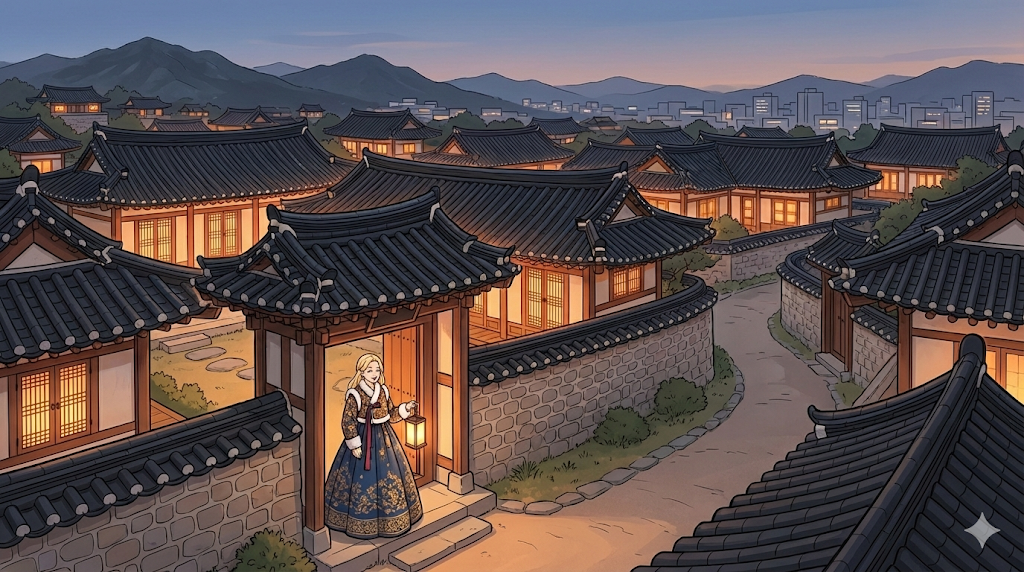
Level 1: The “Low Beam” Disaster
Flashback: My first night in Bukchon Hanok Village.
Initially, I was mesmerized by the smell of ancient pine wood and the beautiful courtyard (Madang). So, I rushed into my room to take a photo. Unfortunately, I forgot that Hanok doors and ceilings are much lower than modern buildings.
Instead of a perfect photo, I hit my head on the wooden beam with a loud “Thud!” Eventually, Ssam brought me an ice pack and a lesson. “Alice, a Hanok requires you to bow your head; it’s a house that teaches you humility,” he whispered. For this reason, I learned to move slowly and gracefully, just like the ancestors did.
Level 2: The Solution (The Beauty of Minimalism)
Immediately, I realized that a Hanok is empty for a reason. “The beauty of the ‘Daechong-maru’ (porch) is that it connects the inside with the outside,” Ssam explained.
1. The “Yo” (The Floor Bed)
First, don’t look for a mattress.
- The Reality: You will sleep on a thick, quilted pad called a “Yo.” * The Benefit: Because of the Ondol (floor heating), the warmth goes directly into your spine. Indeed, it’s the best treatment for a tired back after a day of walking!
2. Hanji (The Breathing Windows)
Next, look at the windows made of mulberry paper.
- The Magic: They allow air to circulate while keeping the room warm. Consequently, you wake up feeling refreshed because you’ve been breathing fresh air all night.
Level 3: The Four Seasons of Hanok
(Why visit in any weather?)
Harmony with Nature
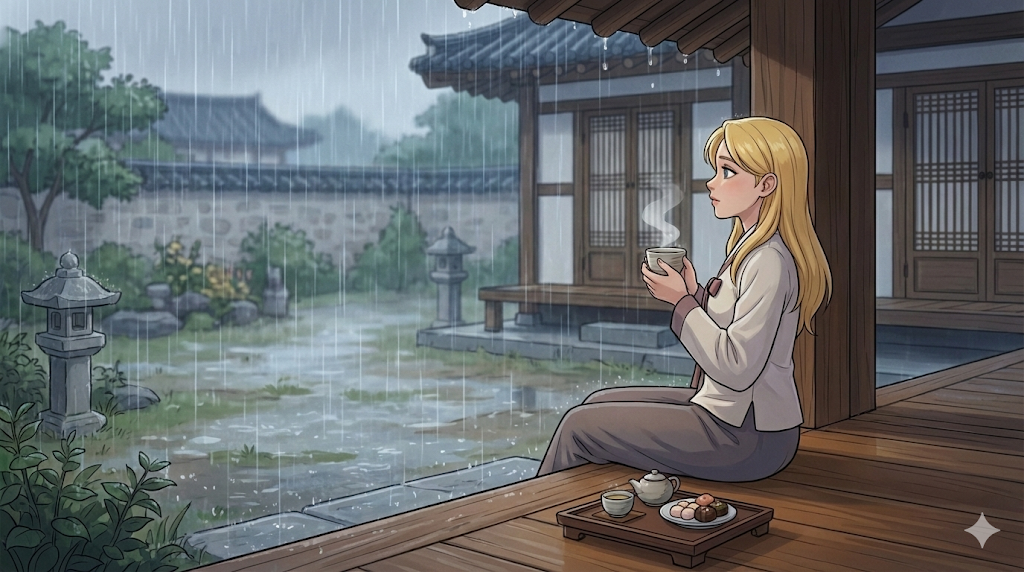
You might wonder, “Is it cold in winter or hot in summer?” Fundamentally, Hanok is a scientific masterpiece. Specifically, the Maru (wooden porch) keeps the house cool in the summer by creating a natural breeze.
Therefore, sitting on the Maru with a bowl of watermelon is the ultimate summer vibe. Moreover, in winter, the thick mud walls and Ondol keep the heat inside for hours. Indeed, watching the snow fall into the central “Madang” (courtyard) from a warm room is the most peaceful moment you can have in Korea.
Level 4: Ssam’s Insight (Bukchon vs. Jeonju)
In 2026, there are many places to experience this. Specifically, Ssam recommends:
- Bukchon (Seoul): Best for a quick “City Escape” with a view of the N Seoul Tower behind traditional roofs.
- Jeonju (Jeollabuk-do): The “Foodie Paradise.” The Hanok village there is massive, and you can eat the best Bibimbap in the country right next door.
Alice’s Bottom Line: Leave Your Stress at the Gate
A Hanok is more than just a place to sleep; it’s a place to reset your soul. If you can handle sleeping on the floor and a few low beams, you will discover a level of peace you can’t find in a 5-star hotel. Therefore, put away your smartphone, listen to the wind, and let the Hanok heal you. Indeed, you haven’t truly seen Korea until you’ve lived under a Giwa roof.
Survival Hangul: Hanok Edition
- “방이 따뜻해요?”
- Pronunciation: (Bang-i tta-tteut-hae-yo?)
- Meaning: Is the room warm? (Checking the Ondol!)
- “이불 더 주세요.”
- Pronunciation: (I-bul deo ju-se-yo)
- Meaning: Please give me more blankets.
- “화장실이 어디예요?”
- Pronunciation: (Hwa-jang-sil-i eo-di-ye-yo?)
- Meaning: Where is the restroom? (Important! Some traditional Hanoks have them outside!)
Read This Next (Recommended for You)
- Ready for some high-tech contrast? [Is South Korea Living in the Future? 5 Reasons It Feels Like 2077]
- Need to check the best date for your traditional stay? [Lunar vs Solar Calendar in Korea: Why Birthdays Change]
- Start a traditional day with a lucky bowl: [New Year’s Day in Korea: Why It’s a Holiday & What to Do]