If you have ever attended a Korean party, you have probably seen a beautiful, shiny pile of noodles mixed with colorful vegetables. Specifically, Japchae is a sweet and savory dish made from sweet potato starch noodles (Dangmyeon). However, many beginners are intimidated because they think they have to stir-fry every ingredient separately for hours.
Consequently, people often avoid making it at home. Fortunately, I discovered a “one-pan” method that keeps the noodles springy and the vegetables fresh.
Welcome to Level 1. Let me tell you about the time I turned my Japchae into a giant, grey, sticky brick.
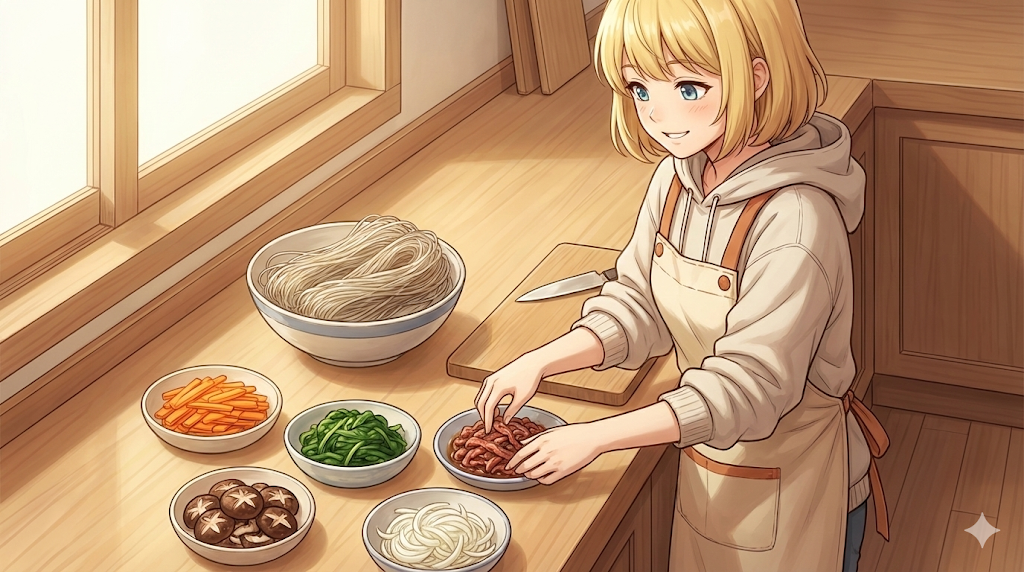
Level 1: The “Noodle Brick” Disaster
Flashback: My first attempt at a potluck dinner.
Initially, I thought glass noodles were just like Italian pasta. So, I boiled them until they were very soft and left them in a colander for 20 minutes while I chopped the vegetables. Unfortunately, when I came back, the noodles had fused together into a solid, unmovable mass.
Instead of a silky stir-fry, I had a “noodle cake.” Furthermore, because I didn’t season the noodles immediately, they tasted like nothing but water. Eventually, I had to hide the dish and order fried chicken for my guests. For this reason, I begged Ssam to show me the non-sticky secret.
Level 2: The Solution (The Non-Sticky Secret)
Immediately, Ssam pointed at the seasoning bowl. “Alice, the secret is seasoning the noodles while they are still hot! This creates a barrier so they don’t stick.”
Follow this Easy Japchae Recipe for a foolproof result.
Step 1: Prep the “Rainbow”
First, slice your vegetables into thin strips.
- Selection: Use carrots (orange), spinach (green), onions (white), and mushrooms (brown) for color balance.
- Action: Briefly sauté the beef and vegetables in a pan with a pinch of salt. Set them aside on a large plate to cool.
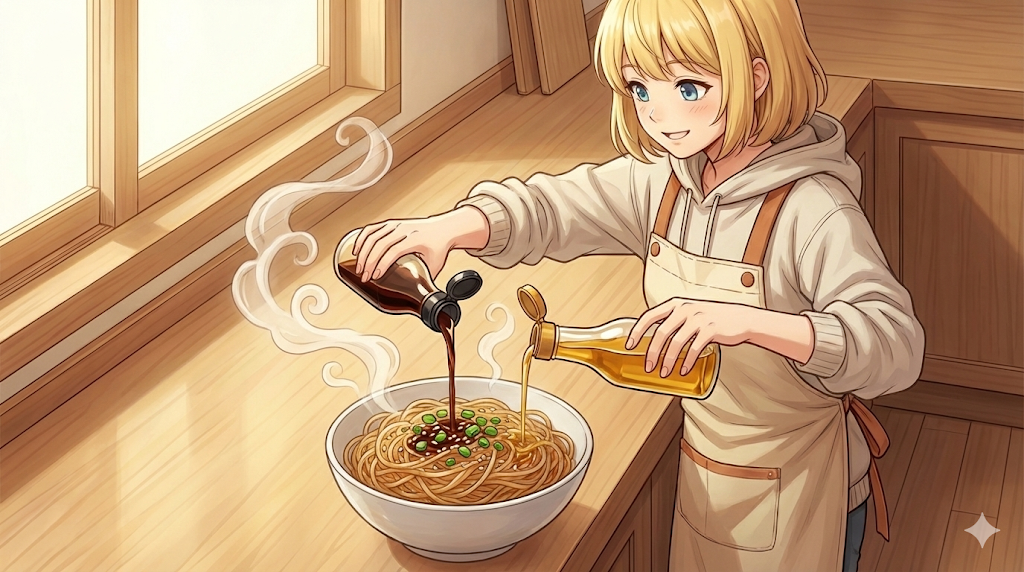
Step 2: Boiling and The “Hot Seasoning”
Next, boil the glass noodles for exactly 6 to 7 minutes.
- The Hack: Do not rinse them in cold water!
- Action: Drain the water and immediately put the hot noodles into a large bowl.
- Seasoning: Add 4 tbsp of soy sauce, 2 tbsp of sugar, and 2 tbsp of sesame oil. By doing this, the noodles absorb the flavor instantly and stay separated thanks to the oil coating.
Step 3: The Great Union
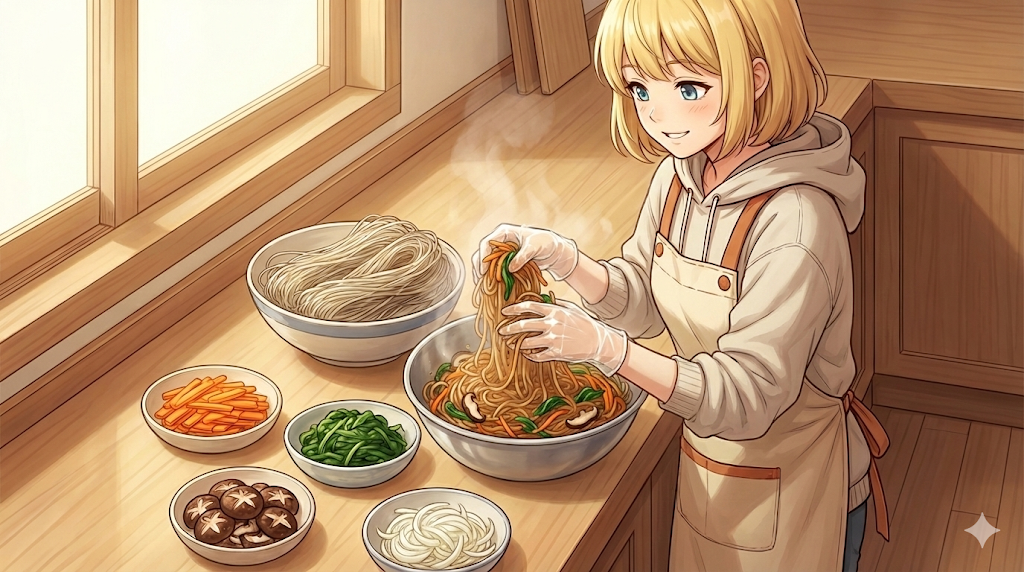
Subsequently, add the previously sautéed vegetables and beef into the bowl with the seasoned noodles.
- Technique: Use your hands (wear plastic gloves if it’s too hot!) to mix everything gently.
- Pro Tip: Mixing by hand, called “Son-mat” (hand taste), ensures every strand of noodle is coated evenly and prevents breaking.
Step 4: The Final Garnish
Finally, transfer the mixed Japchae to a beautiful serving plate.
- Touch: Sprinkle a generous amount of toasted sesame seeds on top for nutty flavor and visual appeal.
- Serving: It can be eaten hot right away or at room temperature later. Indeed, many Koreans believe it tastes even better the next day after the flavors have melded!

Level 3: Ssam’s Insight (The Meaning of Japchae)
(Why is it a party food?)
The Harmony of Ingredients
You might wonder, “Why do Koreans put so many different things in one dish?” Historically, the word “Japchae” literally means “mixed vegetables” (Jap = Mixed, Chae = Vegetable). Specifically, it represents harmony and balance among diverse elements.
For this reason, it is always served at important events like birthdays and weddings to symbolize a long, harmonious, and prosperous life. Moreover, the colorful “Obangsaek” (five traditional colors representing the elements) are believed to bring good health and luck to the person eating it.
Alice’s Bottom Line: Season While Hot
The biggest takeaway of this Easy Japchae Recipe is the order of seasoning. If you season the noodles while they are steaming hot, they will stay glossy and separate for hours. Therefore, be bold with the sesame oil! Indeed, follow these steps, and you are just 15 minutes away from a royal Korean feast.
Survival Hangul: Japchae Edition
- “잡채 좀 더 주세요.”
- Pronunciation: (Jap-chae jom deo ju-se-yo)
- Meaning: Please give me some more Japchae.
- “안 짜고 맛있어요!”
- Pronunciation: (An jja-go mat-it-seo-yo!)
- Meaning: It’s not salty and it’s delicious!
- “당면 어디 있어요?”
- Pronunciation: (Dang-myeon eo-di it-seo-yo?)
- Meaning: Where are the glass noodles?