If there is one dish that defines the Korean spirit, it is Kimchi Jjigae (Kimchi Stew). Specifically, it is the ultimate comfort food that Koreans crave after a long trip abroad. However, many beginners fail to get that deep, “Umami” flavor because they use the wrong kind of Kimchi.
Consequently, your stew might taste like a sour soup rather than a rich, savory masterpiece. Fortunately, I have Ssam to teach me the “Pork and Sugar” hack that fixes everything.
Welcome to Level 1. Let me tell you about the time I tried to make Kimchi Jjigae with expensive, fresh Kimchi and ended up with “Warm Salad Water.”
Level 1: The “Fresh Kimchi” Mistake
Flashback: My first attempt to impress Ssam with my cooking.
Initially, I went to the premium supermarket and bought the freshest, crunchiest Kimchi available. So, I boiled it with water and pork, thinking the quality of the Kimchi would make it taste better. Unfortunately, the result was tragic.
Instead of a deep red, savory stew, I had a pale broth with crunchy, bitter cabbage. Eventually, Ssam took one look and laughed. “Alice, you can’t make a soul food stew with a ‘Young’ Kimchi,” he said. For this reason, I learned that for the Best Kimchi Jjigae Recipe, you need Kimchi that is so sour it makes your eyes water!
Level 2: The Solution (The Sauté Technique)
Immediately, Ssam pulled out a jar of “Mueun-ji” (Long-aged Kimchi) from the back of the fridge. “The older, the better. And you must fry it first!”
Follow these steps for a restaurant-quality bowl:
Step 1: The Fat and The Acid
First, slice your pork belly into bite-sized pieces.
- Action: Sauté the pork in a pot until the fat starts to melt.
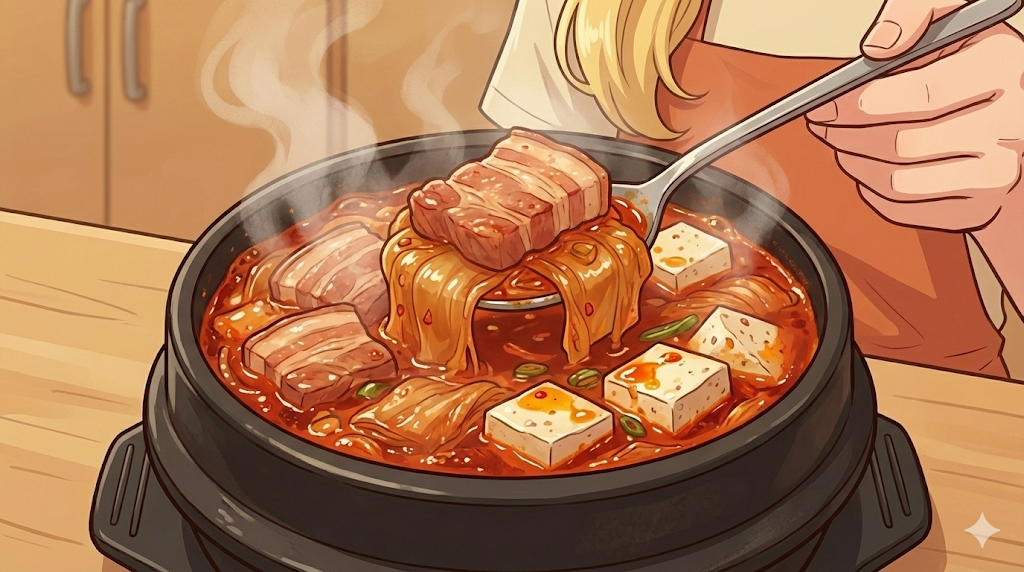
- The Secret: Add the sour Kimchi and sauté it with the pork fat for at least 5 minutes. By doing this, the Kimchi softens and absorbs the savory flavor of the meat.

Step 2: The “Sugar Hack”
Next, add water or kelp broth until it just covers the ingredients.
- The Problem: Sometimes old Kimchi is too sour.
- The Hack: Add 1 teaspoon of sugar. Consequently, the sugar neutralizes the harsh acidity and brings out the hidden savory notes.
Step 3: Boiling and Seasoning
Subsequently, bring it to a boil, then lower the heat.
- Action: Let it simmer for at least 15-20 minutes. Indeed, Kimchi Jjigae is one of those dishes that tastes better the longer you cook it.
- Addition: Add 1 tbsp of minced garlic and 1 tbsp of Gochugaru (Chili flakes) for a deep red color.

Step 4: The Tofu Finish
Finally, add thick slices of tofu on top.
- Action: Let it boil for another 5 minutes until the tofu is heated through.
- Serving: Always serve it with a bowl of warm white rice. Indeed, a spoonful of stew mixed with rice is heaven.
Level 3: Ssam’s Insight (The Art of Aging)
(Why the pork belly?)
The Science of Fat and Fiber
You might wonder, “Why use fatty pork instead of lean meat?” Fundamentally, the lactic acid in old Kimchi can make the broth very sharp. Specifically, the fat from the pork belly emulsifies with the sour juice, creating a silky, creamy texture in the soup.
For this reason, Koreans believe that “Pork and Kimchi” are the ultimate soulmates. Moreover, it is a great way to use up Kimchi that is too sour to eat as a side dish!
Alice’s Bottom Line: Be Patient
The most important takeaway for the Best Kimchi Jjigae Recipe is patience. If you rush the sautéing or boiling, the flavors won’t meld. Therefore, take your time to let the pork fat and sour Kimchi dance together. Indeed, you are just 30 minutes away from understanding the heart of Korea!
Survival Hangul: Stew Edition
- “김치찌개 덜 맵게 해주세요.”
- Pronunciation: (Gim-chi-jji-gae deol maep-ge hae-ju-se-yo)
- Meaning: Please make the Kimchi stew less spicy.
- “고기 많이 넣어주세요!”
- Pronunciation: (Go-gi ma-ni neo-eo-ju-se-yo!)
- Meaning: Please put in a lot of meat!
- “공깃밥 하나 더 주세요.”
- Pronunciation: (Gong-git-bap ha-na deo ju-se-yo)
- Meaning: One more bowl of rice, please.